
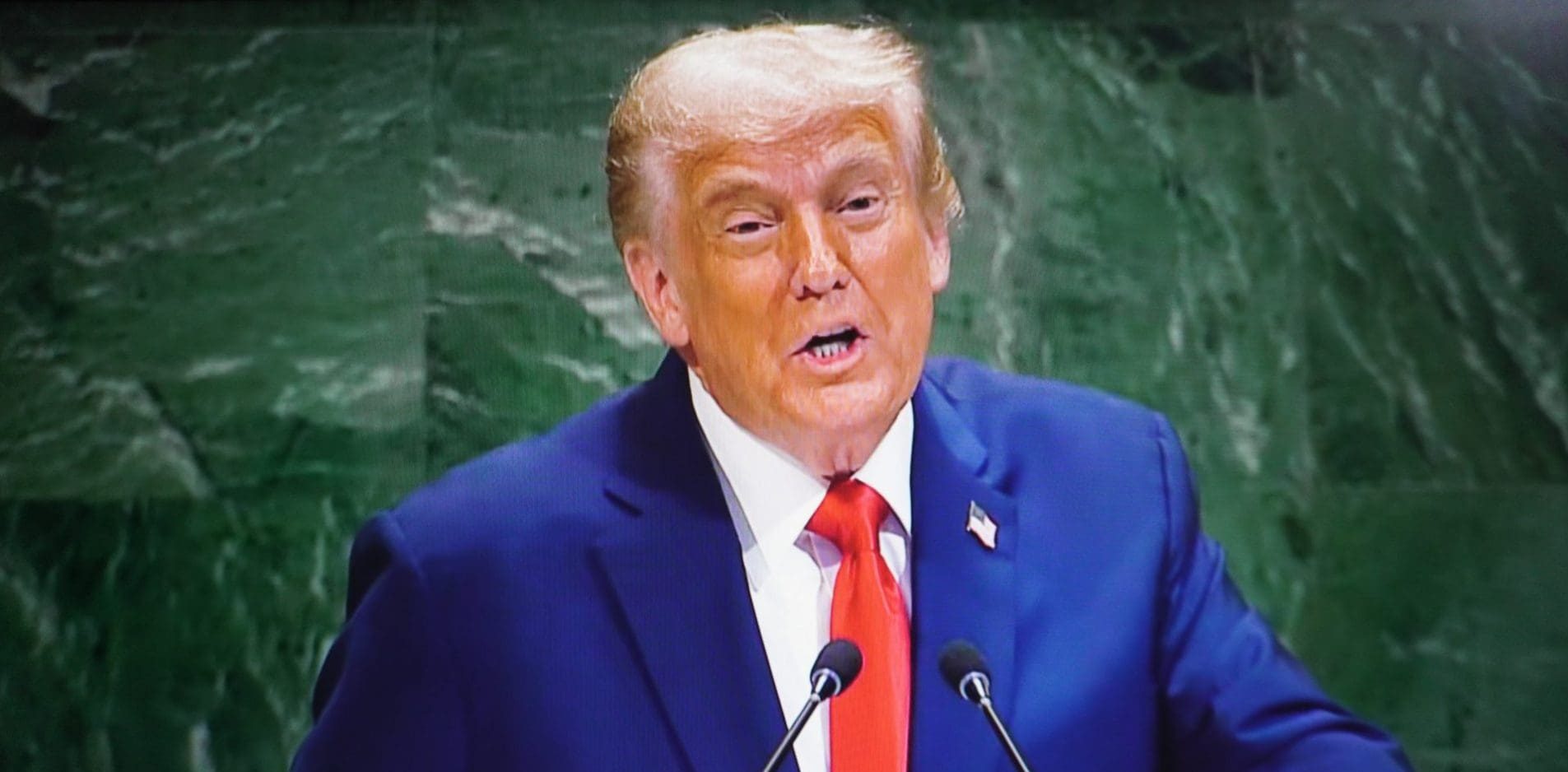
The United States in 2025 is far from the “United” namesake bestowed upon it years ago. Instead, it is divided between those who support the ideals of equal rights for all and those who support a concentration of power that imparts rights for some.
The Trump administration’s dismantling of the rule of law and attacks on civil society—bolstered by the tenets of white supremacy—have only deepened those divisions.
Its actions pose a significant threat to racial justice by eroding legal protections, silencing dissent, and destabilizing the very institutions tasked with advancing racial justice and human rights. These actions are a direct and intentional attack on racial equity, echoing historical patterns used to suppress movements across the world.
The beginning of Donald Trump’s second term shows us that the country’s longstanding undercurrent of white supremacy has not only “resurfaced” but has been sanctioned, codified, and weaponized at the highest levels of power. The Trump administration has embraced authoritarian practices and weaponized the law, often specifically targeting laws and policies that have championed racial equality.
Accelerating White Supremacy
The impact of these actions extends far beyond the federal government, as others are emboldened by the President’s actions. From the executive branch to police departments, school boards, and immigration courts, systems are being recalibrated—not to advance equity or justice—but to reinforce a specific racial hierarchy in which the human rights of white people alone are respected.
Dreams of a white nationalist country are not new, but those desires have now been manifested in mainstream policy decisions and everyday acts of dehumanization. We are not witnessing a temporary backlash to increased equality; we are watching the consolidation of a white supremacist ideology that is no longer fringe or fleeting, but increasingly foundational and existentially dangerous for Black and brown communities. White supremacy has served as the scaffolding on which this country was built—through widespread atrocities against Indigenous people, the transatlantic slave trade, Jim Crow segregation, and the prison-industrial complex. But what we are experiencing in 2025 is a strategic acceleration of this legacy.
The past nine months have shown us what happens when a government abandons even the pretense of racial neutrality. In January and February alone, President Trump signed a flurry of executive orders targeting programs that seek to address longstanding racial disparities, such as Diversity, Equity & Inclusion (DEI) programs. These are not just culture war talking points—they are deliberate attempts to silence truths about the United States’ racist past and present.
Undermining the Rule of Law
It is the obligation of the government to respect, protect and fulfill human rights. And that means protecting people’s rights—including the right to equality—in law. What we’ve seen from the Trump administration, however, is an undermining of the very rule of law—ignoring laws and court rulings it finds inconvenient or in contrast to its political end. The insistence of the current administration to abide by only the court rulings they like poses a particular and significant threat to racial justice.
This has been particularly apparent in cases involving illegal and inhumane policies and actions under the guise of public safety and immigration enforcement. The president has publicly asserted expansive power (invoking dubious legal claims of authority) and identified his intent to deploy troops to Democrat-led cities with high Black and brown populations over inflated claims of crime. These actions serve as an attempted normalization of the militarization of domestic politics.
Militarization of domestic governance, normalization of force against political opponents/municipal authorities, and claims of “unquestioned” executive power are hallmarks of authoritarian consolidation, and efforts to ignore judicial checks on this behavior set a dangerous precedent.
Undermining judicial independence weakens protections for marginalized communities, especially where courts have been the only recourse against discriminatory laws or policies. Yet the executive branch is making determinations on a whim and rejecting court rulings that protect the non-white community.
In an effort to appear strong and assert itself as the sole authority, this administration has sought to eliminate important agencies—like the Department of Education’s Office for Civil Rights or environmental justice offices—further eroding already tenuous protections for communities of color. Furthermore, the efforts to eliminate the Department of Education is not only based in racist segregationist thought but also remove the protections for equity in education and the human right to have such. Furthering white supremacist views and their entrenchment in education, the administration is also removing funding from diverse urban school districts for doing any work related to racial equity and addressing systemic racism in the learning environment.
In 2020, many people protested around the country for better treatment and a modicum of equality. In the current climate, however, the right to protest has been hijacked, and fear of illegal detention has placed a chilling effect on mobilization efforts, especially for communities of color. With the current state of play in the court system, many view it as too risky or a danger to their family’s well-being to exercise their human rights.
Choosing Who is “Acceptable”
While the courts are being ignored and the administration is set on being the sole arbiter of who is and is not worthy of being in the United States, racial justice is not just sacrificed, racial injustice is championed. Consider the administration’s welcoming of white South Africans as refugees into the country. In a time when Black and brown migrants are being torn from their families, targeted and rounded up at their jobs, schools, places of worship, and courthouses, arbitrarily arrested and detained, and in some cases disappeared to other countries whose governments and prisons have documented human rights abuses, the open arms approach to a group of white migrants rings a loud bell in the face of justice.
Following that act, efforts have also been undertaken by the administration to modify the United States refugee system to a system that prioritizes settling white and European immigrants while also demonizing those coming from non-European nations.
When comparing the expedited refugee status and potential pathways to citizenship for white South Africans to the treatment of all others seeking to enter or stay in this country, the contradiction is as stark as it is racist: white people are framed as deserving, while others are unjustly criminalized. This administration makes clear that whiteness opens doors, while proximity to Blackness closes them.
Free From Equality
Under international law, human rights are universal, inalienable, indivisible and interdependent. Yet for millions of people in the United States, these rights are contingent on the color of their skin, their country of origin, their name, or their accent. Currently, safety, dignity, and belonging are no longer a shared promise—it’s a tiered system. And those deemed to be outside the acceptable boundaries of whiteness are left vulnerable to violence, state neglect, and societal hostility.
The Trump administration’s disregard for the rule of law and attacks on civil society pose a grave danger to racial justice. Legal protections aiming to ensure access to equal human rights have been gutted, and more are sure to be targeted in the near future, and the authoritarian tactics to preserve these inequities are evidenced by direct attacks to civil society.
Erasing History
The Trump administration has launched a concerted effort to rewrite and sanitize the United States’ historical narrative, effectively seeking to erase the lived experiences of slavery, racism, Indigenous dispossession, and other uncomfortable truths. For example, his March 2025 executive order titled “Restoring Truth and Sanity to American History” directs the Smithsonian Institution and other federal cultural institutions to purge exhibits that “inappropriately disparage Americans” and to restore monuments or statues that had been removed on the grounds of “false reconstructions” of history.
In practice, this has meant cutting grants to museums that discuss accurate Black history. At the same time, the administration has ordered the removal of photographs that illustrate the brutality of slavery — for instance, the 1863 image of a formerly enslaved man’s scarred back (known as The Scourged Back) was ordered removed in Georgia. Additionally, statues and memorials that had been removed or relocated — including Confederate monuments — are being reinstated under the guise of restoring “true” American history.
Such actions reflect a full embrace of authoritarian practices: controlling the past by rewriting or erasing it, reshaping public memory to serve a dominant narrative, and punishing institutions that tell inconvenient truths. By tying federal funding, oversight, and content to ideological conformity to “celebrate American exceptionalism,” avoid “divisive narratives,” and purge “anti-American ideology,” the administration is using cultural institutions as levers of power rather than spaces of independent historical inquiry.
When minimizing or excluding Black and brown histories becomes a form of racial control; erasure of minority suffering = erasure of minority voice. By delegitimizing historical facts and controlling how history is represented, power becomes centralized, dissenting narratives are suppressed, and the foundations of a pluralistic society are weakened — exactly the sort of moves associated with authoritarian consolidation of control.
We Can Fight for Racial Justice
As bleak as things may seem, there are actions we can take right now.
We are currently asking Congress to support reparations for Black Americans with HR 40 and H.Res 414 and ask that the President support and ensure the implementation of this important legislation.
And while the court system may be under attack, in California, we just worked alongside coalitions to pass improvements to the state’s Racial Justice Act, which allows for challenges to racially motivated disparities in the justice system. This type of legislation is vital as we see federal protections and pushes for equality undermined at every turn.
Through collective action, we can move forward toward racial justice. It is up to us to do the work.
This blog is part of a series exploring how increasing authoritarian practices impact human rights across a variety of issues. Learn more.