
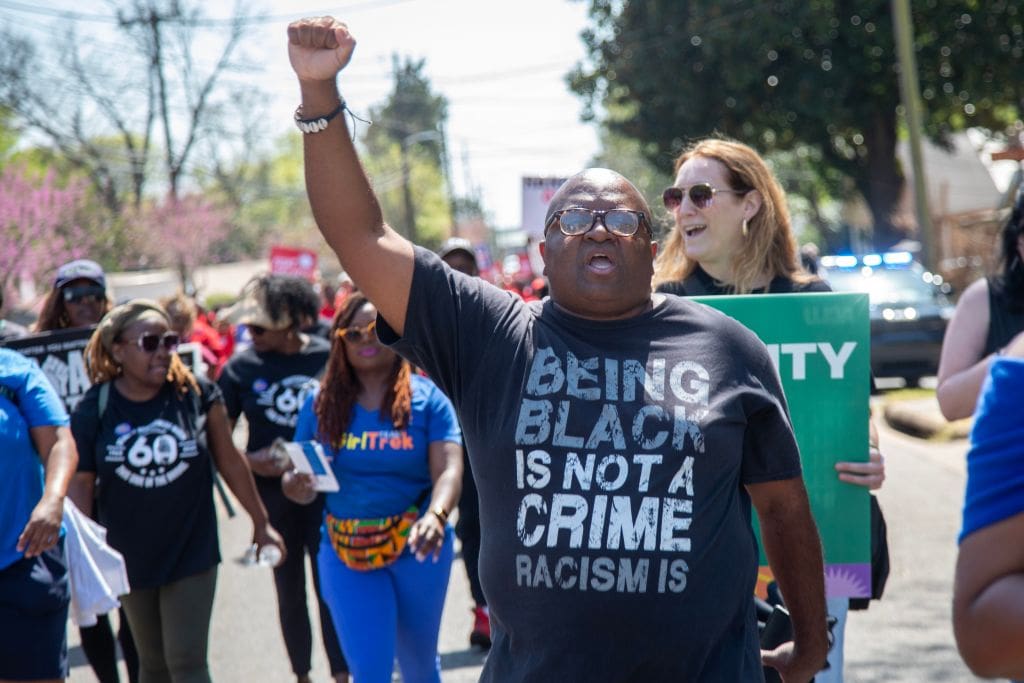
Disparities in charging and sentencing are not new. Communities of color, Black and Brown people, are often disproportionately represented in the incarcerated population and see charges and sentences more elevated when compared to their white peers.
What is the solution?
States like California have introduced legislation, the Racial Justice Act (RJA), to address racial bias in the criminal legal system.
The RJA is intended to challenge racist conduct against individuals in their arrest, criminal court proceedings, charges, or sentences; an RJA claim cannot be filed in a civil lawsuit.
How did we get here?
The RJA was designed in part to undo the precedent the United States Supreme Court set in 1987 with McCleskey v. Kemp, where it ruled that no matter how much evidence a defendant showed of racism or bias in their case, they also had to show that discrimination was purposeful, before the court would consider addressing the issue.
Proving intent is nearly impossible, so many racial injustices have long gone unchecked.
The United States criminal legal system is also rooted in white supremacy. A brief overview of how the system began, has evolved, and endures the legacy of white supremacy is below.
How white supremacy is baked into the justice system
The U.S. justice system, designed to enforce laws and protect communities, has deep roots in white supremacy. From its formation to modern practices, it has disproportionately criminalized communities of color.
Origin of modern policing
Slave patrols were groups of white men who policed enslaved Black people. Their job was to catch them and maintain control through violence and surveillance.
Modern police departments evolved from these patrols, embedding racial control in law enforcement as its foundation.
Now → over-policing
Heavy police presence in Black and Brown neighborhoods leads to more stops and searches despite no higher crime rates.
Mass incarceration devastates families, limits job access and reinforces poverty and trauma in Black and Brown communities.
Prolonged bias
People, including officers, are more likely to view people of color as threatening or dangerous.
In everyday life, people of color are more likely to be stopped, searched, charged, and convicted.
Now → Disparities
Black people are 5x more likely to be incarcerated than white peers and are more likely to be charged with harsher crimes for the same behavior.
Sentences for Black and Brown people are often longer when controlling for a crime’s severity and prior records.
Why it matters?
The Universal Declaration of Human Rights (UDHR) Article VII states:
“All are equal before the law and are entitled without any discrimination to equal protection of the law. All are entitled to equal protection against any discrimination in violation of this Declaration and against any incitement to such discrimination.”
For Black and Brown communities in the United States, this human right is far from protected. In many states, equal protection against discrimination in this legal system is seen by many as a pipe dream.
Creating a pathway to challenge racial bias in the court system is not only the right thing to do, it is imperative.
Make it happen, California!
The Racial Justice Act would be one of the most important and consequential laws enacted in California. AB 1071 is essential to aid courts in seeking to eliminate racial bias from California’s court system. Racism in any form or amount, at any stage of a criminal trial, is intolerable and undermines a fair criminal justice system.
Access to equal protection of the law that is free from discrimination is a human right.
Interested in your state adopting an RJA?
Sign up for more information on RJA actions and how to start the process to push for a version in your state.