
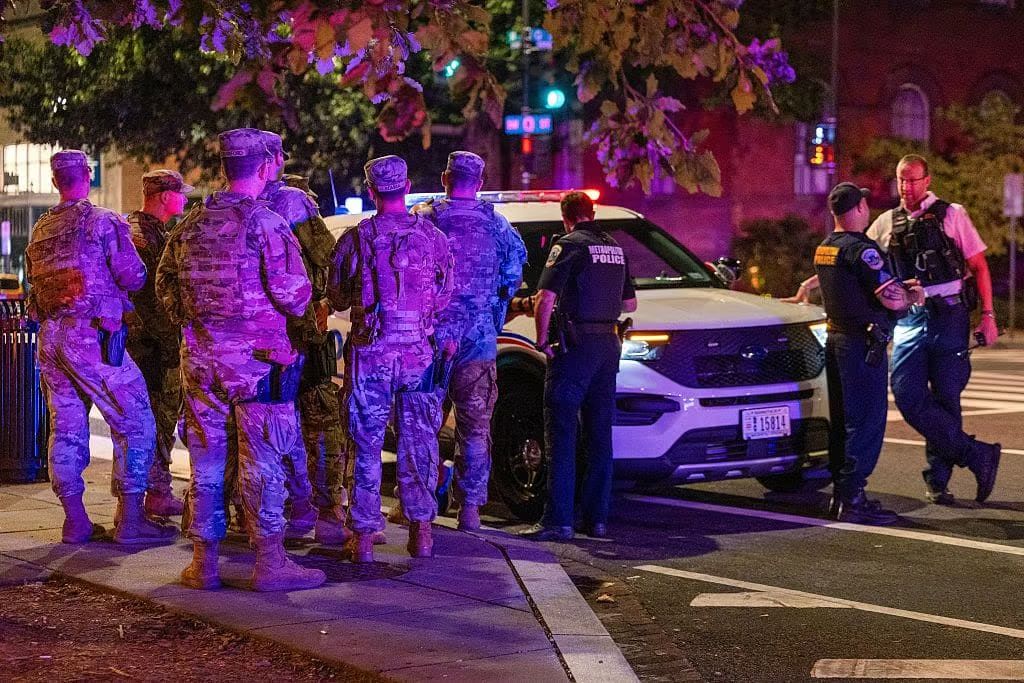
When President Trump ordered the deployment of federal troops to Washington, D.C. in August 2025 and then threatened to do the same in Chicago weeks later, the move was not actually about crime. It was the latest expression of a longstanding racist narrative: that Black and brown communities represent danger, disorder, and lawlessness—and that only overwhelming force can restore control. This problematic and untrue framing has deep historical roots in white supremacy and racist myth-making, and its resurrection in 2025 underlines how “public safety” has often been weaponized against communities of color.
By choosing D.C. and Chicago—two cities with large Black populations and Black elected leaders—Trump signaled more than a law-and-order crackdown. The rhetoric echoes a pattern in U.S. history where Black political and social power is often challenged with violence, all under the guise of protecting a society from crime. The subtext of the words being spoken is this, Black cities are threats to national stability and federal militarization is the only solution.
From D.C. to Chicago: The Escalation
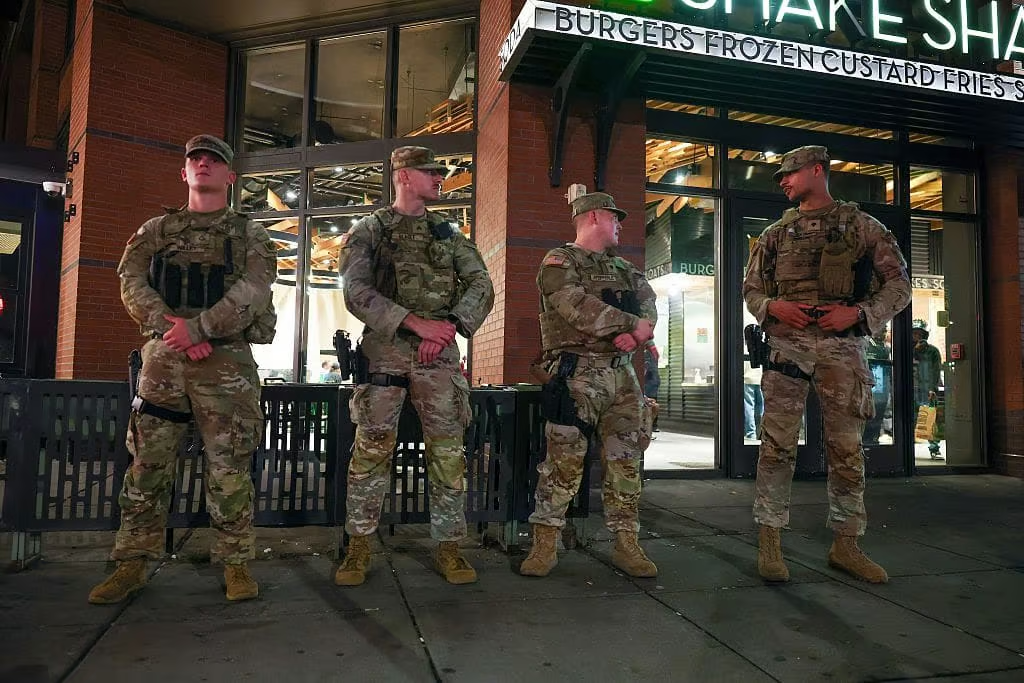
On August 11, 2025, Trump declared a crime emergency in Washington, D.C., invoking provisions of the D.C. Home Rule Act to seize authority over the city’s police. Federal agents and 800 National Guard troops poured into the capital despite the fact that violent crime was at a 30-year low.
Federal agents alongside the police arrested nearly 600 people in a two-week period, often on minor offenses that they could not clearly articulate. The image on television was militaristic and the signal to those watching was clear, the good guys are here to address the bad guys…aka those who aren’t white.
By late August, Trump suggested Chicago could be next. The President suggested sending thousands of National Guard troops, ICE agents, and federal law enforcement to address “crime, homelessness, and illegal immigration.” Illinois Governor J.B. Pritzker and Chicago Mayor Brandon Johnson immediately condemned the plan as unconstitutional and promised legal resistance.
The Racial Targeting of Black-Led Cities
Trump’s deployment strategy has not been random. D.C., Chicago, New York, Baltimore, Los Angeles—these are not only cities where a majority of people did not vote for him, but they are also cities with large Black and brown populations and Black leadership. The purported crime wave justification collapses under the smallest of scrutiny: Chicago homicides are down 30% this year, shootings down 36%, and overall violent crime down more than 20%, yet the city is still being painted as a symbol of urban lawlessness and decay.
This mirrors historical racial narratives that construct Black spaces as inherently dangerous. From the post-Reconstruction portrayal of newly emancipated Black communities as violent and ungovernable, to the mid-20th century demonization of urban uprisings, to the “super predator” myth of the 1990s, the U.S. has repeatedly used crime as a coded proxy for Blackness. Trump’s words and actions fit squarely into this lineage, weaponizing fear of Blackness to justify extraordinary measures of control.
Historical Parallels: The Long Arc of Criminalization
-
Reconstruction Backlash (1870s–1890s):
After Black men gained political power in the South, paramilitary groups like the Red Shirts and White League justified their terror campaigns as necessary to suppress “lawlessness.” The federal government did little to stop or address these actions and decried the virtues of public safety.
-
Civil Rights Era (1950s–60s):
Black protests were routinely cast as “riots,” met with militarized policing rather than redress of systemic injustice. President Lyndon Johnson’s 1965 deployment of troops in Watts and President Johnson’s 1968 Kerner Commission response illustrate this, concluding poverty and institutionalized racism were key drivers of urban Black struggles.
-
War on Drugs & War on Crime (1970s–90s):
Black neighborhoods were painted as crime zones, justifying aggressive policing, mass incarceration, and the militarization of local departments. The war on drugs was later confirmed by the architect to be designed as a way to demean, denigrate, and incarcerate Black people. These types of policies entrench the concept of racial control within a legal cover.
Today, Trump’s strategy resurrects these traditions. By declaring emergencies in cities where crime is falling, his actions expose not a concern for safety, but a political calculus steeped in racial scapegoating.
This is not the first time. In 2020, the Trump administration sent federal forces to Portland and other cities during racial justice protests, often escalating violence rather than reducing it. The difference now is scale: the 2025 deployments involve thousands of troops and the direct seizure of local policing powers—measures unseen in modern U.S. governance.
A Dangerous Strategy
The danger of this strategy extends beyond policing. When the federal government treats cities with large Black and brown populations as threats to national order, it normalizes authoritarian control while undermining local protections and civil rights. If unchecked, these moves could create a precedent for federalized crackdowns against any area that opposes policies of the current administration.
As with other authoritarian practices, the racial subtext corrodes public trust. Communities that have endured generations of over-policing and underinvestment recognize this for what it is: another form of racial domination dressed up as crime control.
Crime is Down, Racism is Up
Crime is falling in Chicago and other cities Trump has targeted. What these communities need is not soldiers on their streets but investment in housing, jobs, schools, and violence prevention programs—strategies proven to reduce harm without criminalizing communities.
In Baltimore, a city under fire by Trump, under the leadership of Mayor Brandon Scott the city has seen a 50-year low in gun violence and homicides. Crime overall has gone down significantly. This has been done through intentional investment in the community and in the youth of the city, bringing resources to the Black and brown communities, and creating a culture of respect.
Militarization will not solve gun violence or economic inequality. It will only deepen wounds and reinforce the historical pattern of treating Black life as disposable and Black leadership as illegitimate.
Not About Safety
Donald Trump’s threats against Chicago and his deployment in Washington, D.C. should be understood not as public safety measures, but as racist exercises of power and a dangerous display of authoritarian practices. By casting cities with large Black and brown populations as enemy territory, the administration is reviving one of the oldest traditions: controlling communities of color through force, justified by myths of lawlessness.
Addressing this pattern calls for mass mobilization and solidarity across multiple communities. It takes seeing these attacks and this rhetoric for what it is, racial injustice.