
The Israeli military’s deliberate destruction of civilian homes in Quneitra governorate in southern Syria since December 2024, with no absolute military necessity, should be investigated as war crimes, said Amnesty International today. Israel has an obligation to make reparations for these serious violations of international humanitarian law, which should be tailored towards addressing the specific harms faced by the victims.
On December 8, 2024 – the day the former Syrian government led by Bashar al-Assad fell – Israeli military forces crossed through the Golan Heights, a Syrian territory Israel has occupied since 1967, into three villages and towns located within the UN-Demilitarized zone in the Quneitra governorate in southern Syria, conducting home raids and ordering residents to leave.
Over the following six months, the Israeli military destroyed or damaged at least 23 civilian structures in three villages, which witnesses described as their and their neighbors’ homes and said had the effect of displacing entire families. Amnesty International was able to verify through satellite imagery the damage and destruction to 23 structures in these villages. Witnesses reported that at least two additional homes were destroyed, as well as adjacent gardens and agricultural land, in 2024 and 2025. There were no active hostilities immediately prior, during or after the destruction to civilian buildings. Generally, international humanitarian law applies to any attacks Israel conducts throughout Syrian territory. In areas that Israel occupies, the law of occupation imposes additional obligations, including under the Fourth Geneva Convention.
“The unlawful destruction of civilian property has become a hallmark of Israel’s military operations in the region, documented over the past years in Gaza and Lebanon, and now, as our investigation has established, in Syria as well. Our research has shown how Israeli forces have, repeatedly and deliberately, forced families from their homes and then destroyed them in clear violation of international humanitarian law. Securing Israel’s border cannot be used to justify bulldozing and blowing up people’s homes and villages on the territory of another country,” said Kristine Beckerle, Amnesty International’s Deputy Regional Director for the Middle East and North Africa.
“Families in southern Syria survived a decade-long conflict, many of them having already rebuilt their homes during that period, only to see those homes demolished once again, without any absolute military necessity.”
Amnesty International interviewed eight residents of Quneitra governorate: four whose homes had been demolished, two who witnessed the demolition of their neighbors’ homes, one who had direct knowledge of damage caused by Israeli forces to a governorate building, and a local representative. Interviewee accounts, corroborated by media reports, indicate there were no active hostilities immediately prior, during or after the damage and destruction to civilian buildings in southern Syria. Amnesty International verified 35 videos and images, some of which showed bulldozers demolishing homes or rubble of apparent homes in the villages. It also reviewed media reports, include media based in Israel, statements by the Israeli government, and analyzed satellite imagery for each affected area to confirm demolitions within the time frame described by witnesses.
Amnesty International identified nine military bases built by Israeli forces since December 2024 in Quneitra and Daraa governorates, both located in southern Syria along the border with the Golan Heights, which Israel has occupied since 1967 and which it unlawfully annexed in 1981. Israel has expanded the portions of Syrian territory it occupies. Some of the documented demolished structures were close to either recently constructed Israeli military bases or to an area where a base was later built in areas beyond the occupied Golan Heights.
Israeli officials have repeatedly made broad claims that their military operations and presence in Syria are necessary to prevent threats from Hezbollah or Iran-linked groups based in Syria or to destroy weapons stockpiles or air defense systems. In December 2025, the Israeli Defense Minister said the Israeli military had no plans to withdraw from newly seized positions in Syria.
On April 17, 2026, the Israeli Prime Minister said that Israel had established a “security buffer zone” whose boundary was marked by what he called the “yellow line.” The zone included parts of Syria where Amnesty International documented civilians’ homes damaged and destroyed. It also included the Israel-occupied Golan Heights and parts of southern Lebanon. The Prime Minister said: “This buffer zone completely removes the near threat of invasion and anti-tank fire. The IDF is stationed there, at the ‘Yellow Line,’ to continue defending against the near threat.”
Article 53 of the Fourth Geneva Convention prohibits the destruction of property by an occupying power “except where such destruction is rendered absolutely necessary by military operations.” This prohibition covers not only total but also partial destruction, as well as seizure, of property. The absolute military necessity standard requires that destruction of property be materially indispensable, namely that no other option be available, in the conduct of military operations. In turn, military operations refer to military activities, including movements, maneuvers and preparation, directly related to fighting or combat.
The absolute military necessity standard does not allow an Occupying Power to carry out destruction of property on the basis of broad or abstract strategic goals, such as deterrence or prevention of future attacks, or to pursue the needs of, or implement security measures. Under Article 147 of the Fourth Geneva Convention, “extensive destruction and appropriation of property, not justified by military necessity and carried out unlawfully and wantonly,” constitutes a grave breach, i.e. a war crime.
The Israeli military entered the UN-Demilitarized zone in Quneitra governorate from the Israel-Occupied Golan Heights, claiming the move was necessary to protect against potential threats. After entering the area, the military began demolishing and destroying homes, despite the absence of active hostilities. The Israeli military also established military positions and bases in the area, and eventually announced the area was part of a “security buffer zone.” Families were displaced and their homes demolished without the provision of alternative shelter, compensation or any timeline for their return.
Amnesty International wrote to the Israeli authorities to ask about the criteria used for deciding which properties would be destroyed, including how they determined whether the absolute military necessity standard had been met, along with other questions. No response had been received at the time of publication.
Amnesty International concluded that the destruction of and damages to civilian structures in southern Syria were carried out without absolute necessity dictated by military operations in violation of international humanitarian law, and amount to grave breaches of the Fourth Geneva Convention.
Al-Hamidiya village and surrounding area
As Israeli soldiers entered al-Hamidiya village on December 8, 2024, two residents told Amnesty International that Israeli soldiers ordered the women and girls to leave their homes at around 11 am while they kept most of the men in their homes for questioning until the afternoon, after which they were allowed to rejoin the women and girls. Israeli soldiers ordered at least 10 families to leave their homes and move to other parts of the village. Satellite imagery from December 17, 2024 shows new berms have been constructed and, in January 2025, construction of a new base is visible less than 1000 ft east of the affected area.
Two witnesses whose homes had been demolished told Amnesty International that on June 16, 2025 at 9:30pm they saw at least two bulldozers demolishing homes in the village over the course of two days. The bulldozers continued working into the night before stopping and then resuming work early the next day. A local representative later confirmed to the residents interviewed by Amnesty International, as well as to other families, that their homes had been demolished.
A woman whose home was demolished and garden bulldozed over said: “My husband died during the conflict [in Syria]… He built the house brick by brick. We had a small garden, too. It didn’t give much but enough seasonal vegetables and fruits to save us money on purchasing. My house meant a lot to me and my son… I had a place of my own, and for my son.”
Her neighbor added: “Our home is spacious, next to the house, we have small land with walnuts, pomegranate trees, olive trees and others… everything was bulldozed”.
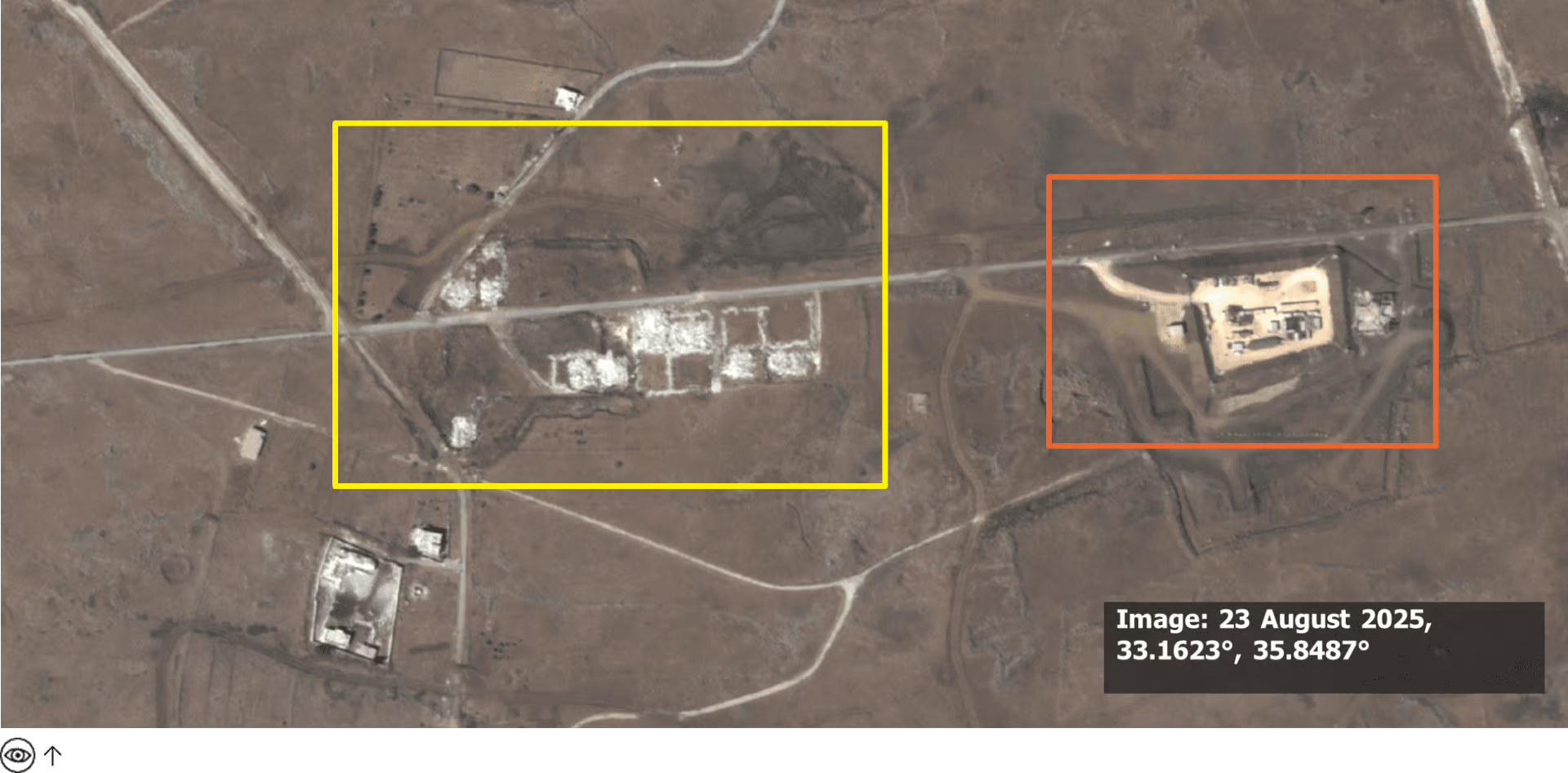
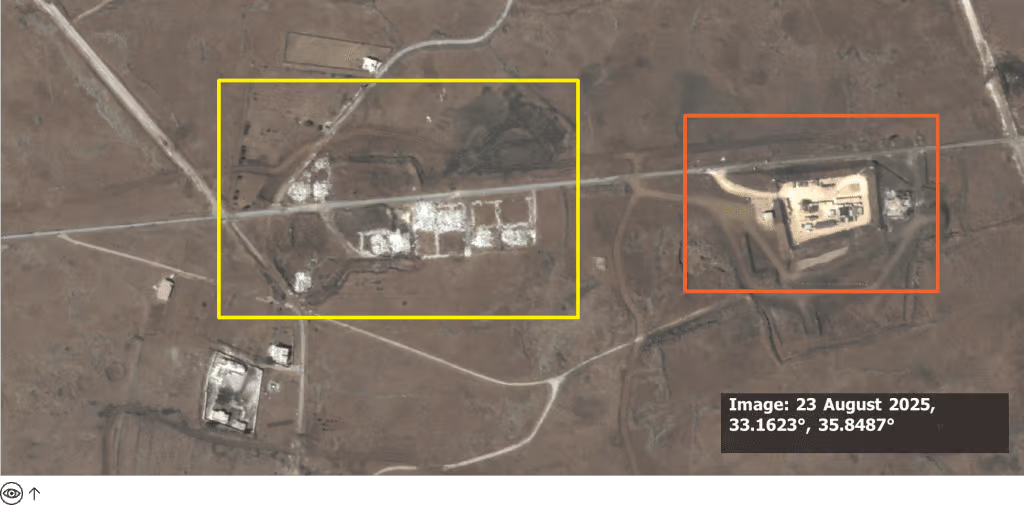
High resolution satellite imagery from August 23, 2025 analysed by Amnesty International’s Evidence Lab shows 14 structures and the walls surrounding them were completely destroyed.
Rassim al-Rawadi village and surrounding area

A resident said that Israeli soldiers entered Rassim al-Rawadi village on December 8, 2024 at around 5:30am, detained residents for several hours in the village’s public school and then ordered all of them to leave the village. The families returned around one month later. During that time, at least three homes were damaged and two demolished, the resident said. He added that he saw bulldozers in his village apparently demolishing homes three days after he and his family were forcibly displaced to a nearby village, around 1 mile away. Amnesty International reviewed videos taken by residents upon their return to their village showing damage and destruction of at least two separate homes.
A resident told Amnesty International that Israeli military forces raided his home and held him, his wife and three children for six hours before ordering them to leave their home. He added that he and the other residents were allowed to return 40 days later, only to find his home reduced to rubble.
Lower resolution satellite imagery analyzed by Amnesty International’s Evidence Lab shows destruction, soil disturbances and trees removed between December 10 and 13 2024. High resolution imagery captured on December 17, 2024 shows in more detail that six structures across the area appear heavily damaged or destroyed and new berms are visible. Trees on the west side of the main road have been removed. In early January 2025, lower resolution imagery shows clearing for a new military base began approximately 1 mile south-west of the village, only 1000 ft from al-Quneitra hospital.
Al-Rafeed village

On December 20, 2024, the Israeli forces entered Al-Rafeed village and demolished at least two homes. According to a resident, the families were sleeping at their relative’s home in town, less than a mile away, when the demolition happened.
A witness told Amnesty International that the two demolished homes were located around 1.5 km from an Israeli military point in the occupied Golan Heights. He described how he saw the Israeli military forces using a bulldozer and other equipment to destroy the home: “The bulldozer turned the house from bricks to sand in minutes… The two homes belonged to people [two brothers and their families] who were already living in destitution. It was heartbreaking to see them displaced, and their home on the ground.”
The Israeli soldiers also demolished a nearby former military base that belonged to the former government of Bashar al-Assad, the resident said.
Lower resolution satellite imagery analyzed by Amnesty International shows probable destruction to structures and trees removed between December 19 and 20, 2024. Higher resolution imagery captured on December 25, 2024, shows in more detail that six structures appear destroyed. Amnesty International’s Evidence Lab verified four videos and six pictures, all published on December 20, 2024, showing Israeli soldiers in the village and destroyed concrete structures.
“Israel’s pattern of destroying civilian homes in Gaza, southern Lebanon and southern Syria has been carried out with total impunity, displacing and shattering the lives of countless families across the region. The international community must unequivocally condemn these actions and exert real pressure to bring these recurring violations to an end and to prevent further devastation of civilian lives across the region. There must be a demand for accountability for those responsible and reparations for those affected,” said Kristine Beckerle.
Contact: [email protected]