
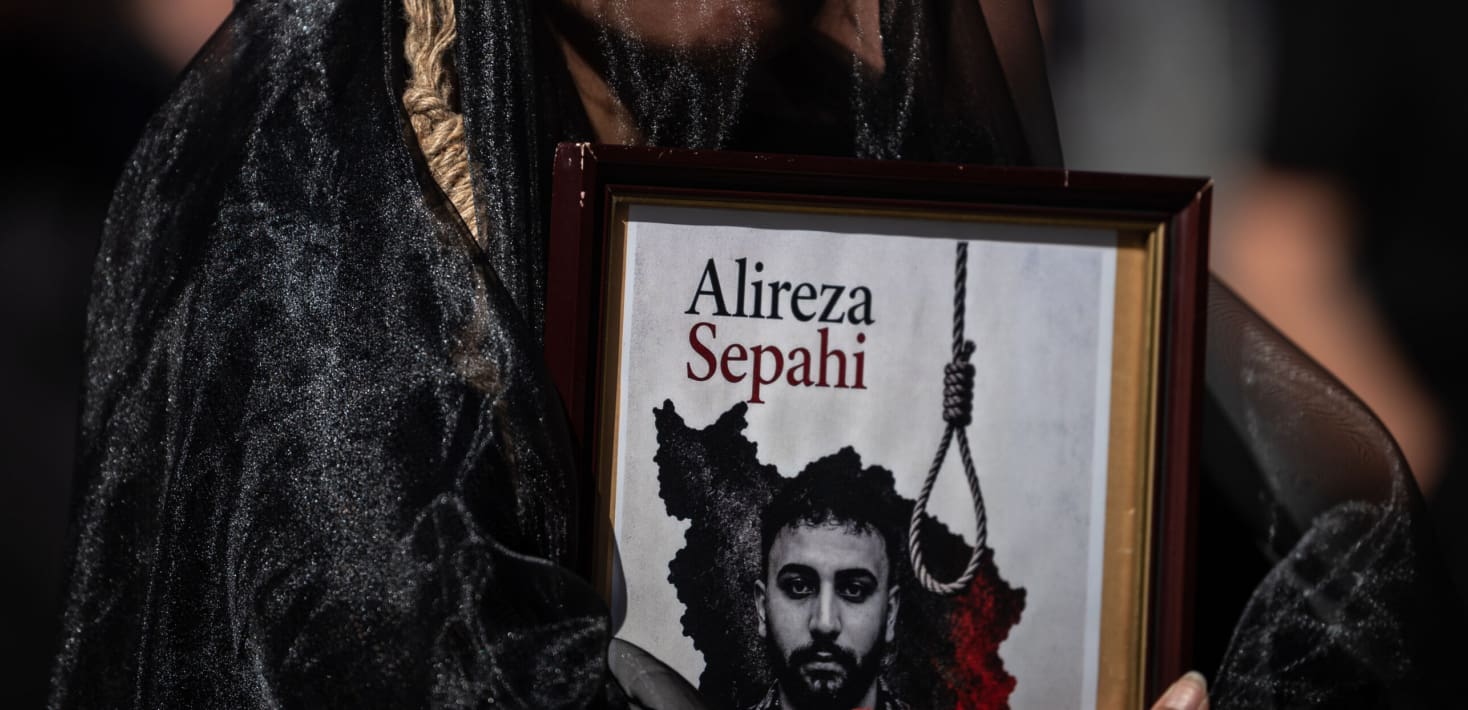
In response to the Iranian authorities arbitrarily executing five people convicted in relation to the January 2026 protests in the space of a week, between September 30 and October 5 – Ali Hemmati Sistanian, Alireza Raisi, Alireza Sepahi, Majid Nikandish and Siavash Jamshidi Kheirabadi – following grossly unfair torture-tainted trials, Diana Eltahawy, Deputy Regional Director for the Middle East and North Africa at Amnesty International said:
“The arbitrary executions of these five young men serves as another chilling reminder of how the Iranian authorities weaponize the death penalty to render the cost of dissent so high that it terrorizes the population into silence and deters further mass uprisings challenging their repressive decades-long rule.
“These executions followed reports illustrating a frightening and familiar pattern: denial of access to lawyers during interrogations, refusal to investigate defendants’ claims of torture and other ill-treatment, accusations of involvement in the killing of members of security forces and other violent and non-violent acts during protests, the use of televised forced ‘confessions’ as evidence, and trials before Revolutionary Courts that are inherently unfair. For instance, Alireza Sepahi reported being subjected to torture and other ill-treatment and was denied access to a lawyer during interrogations at the investigation stage. Such proceedings make a mockery of justice, laying bare the Iranian authorities’ utter disregard for the right to life.
“Scores of people including dissidents and protesters remain at risk of politically motivated executions as authorities intensify repression citing ‘wartime conditions’ and national security threats, increasing the urgent need for coordinated diplomatic pressure on Iran to halt all planned executions.
“Systemic impunity has emboldened Iran’s authorities to continue their assault on the right to life and other human rights, underscoring the urgent need for the referral of the situation in Iran to the International Criminal Court by the UN Security Council and the establishment of an international criminal justice mechanism for Iran through the UN General Assembly.”
Background
Alireza Raisi and Alireza Sepahi were executed in Esfahan on October 5, 2026. According to Mizan News Agency, the judiciary’s media outlet, they were part of the “Alikhani Square” mass trial in which authorities accused defendants of various violent and non-violent acts during protests that took place in Esfahan on January 8, 2026, including blocking streets, destruction of property, arson, and involvement in the deaths of four security agents. The men were sentenced to death after a grossly unfair trial in which their forced “confessions” were broadcast on state media on January 23, 2026, prior to their trial. Amnesty International learned that agents subjected Alireza Sepahi to torture and other ill-treatment in detention, including prolonged solitary confinement, beatings and electric shocks. According to Mizan News Agency, the men were sentenced to death for “‘membership in an armed rebellion group (baghi); ‘waging war against God’ (moharebeh) through drawing weapons and creating fear, terror and insecurity in the surrounding area; and “corruption on earth” (efsad-e fel arz) through acts against individuals’ physical integrity and national security that severely disrupted public order and created widespread insecurity, incitement to war and killing, and other criminal acts, including acts against national security”. Five other men convicted in the same case were previously executed and at least eight others are at risk.
Majid Nikandish and Ali Hemmati Sistanian were executed on September 30, 2026 in Mashhad, Razavi Khorasan province. According to Mizan News Agency, they were accused of various violent and non-violent acts during protests in Mashhad on January 8, 2026 that authorities labelled a “coup”, including blocking streets, destruction of property, arson, and involvement in the deaths of four members of the security forces. Their televised forced “confessions”, including those taken at the scene of their arrest and subsequent interrogations when they had no access to a lawyer, were used as evidence to convict and sentence them to death. According to Iran Human Rights, an independent human rights organization based outside Iran, Majid Nikandish was subjected to torture and other ill-treatment, including through prolonged solitary confinement and suspension from his arms, resulting in a dislocated shoulder and broken jaw.
Siavash Jamshidi Kheirabadi was executed on October 3, 2026 in Shahr-e Kord,Chaharmahal and Bakhtiari province. According to Mizan News Agency, he was convicted and sentenced to death in relation to protests that took place on January 8, 2026 in Shahr-e Kord on the charges of “’waging war against God’ (moharebeh) through drawing a firearm and firing it” and “gathering and colluding to commit crimes against national security”. Amnesty International has consistently documented the use of the latter charge against protesters, dissidents and human rights defenders for taking part in protests and other gatherings. Siavash Jamshidi Kheirabadi forced “confessions” were televised and used as evidence to convict him and sentence him to death.
Iranian authorities have executed at least 34 individuals in relation to the January 2026 uprising, during which security forces used unlawful lethal force on a massive scale, killing thousands of protesters and bystanders on January 8 and 9. Politically motivated executions intensified further following the unlawful US-Israeli attacks on Iran on February 28, 2026, while executions for drug-related and other offenses have continued.
Amnesty International opposes the death penalty unconditionally, for all crimes and under any circumstances.
Contact: [email protected]