
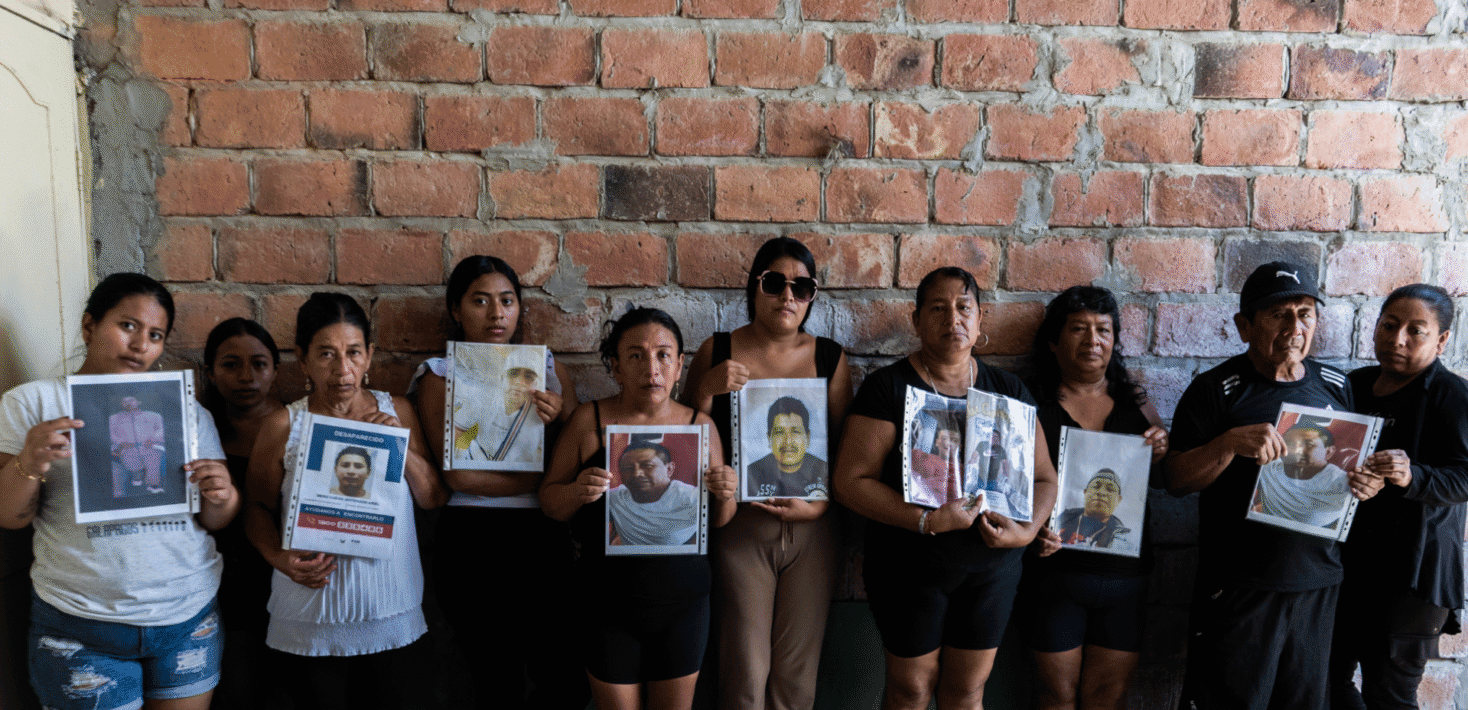
Six months on from a possible U.S. strike against the Ecuadorian vessel Fiorella, Amnesty International recalls that the U.S. policy of carrying out air strikes against boats at sea, under the pretext that they are transporting drugs to the United States, constitutes a practice of extrajudicial executions and other violations of human rights that must cease immediately.
On January 20, 2026, the fishing vessel Fiorella disappeared in international waters, having set sail from the port of Jaramijó in Ecuador seven days earlier. Since then, the whereabouts of eight of its ten crew members are unknown. The indications are that the United States may have assaulted the boat as part of its latest “Southern Spear” counter narcotics operation, in which more than 60 boats have been attacked in the region and over 200 people have been killed since September 2025.
Amnesty International’s Evidence Lab has reconstructed the route covered by the fishing vessel using VMS (vessel monitoring system) data available on the Global Fishing Watch platform, confirming that the Fiorella left the port of Jaramijó, in the province of Manabí, and sailed through Ecuadorian waters towards the Galapagos Islands, which belong to Ecuador.
Amnesty International traveled to the towns of Manta and Jaramijó, where it met with relatives of the eight disappeared fishermen – Gabriel Aladino Mero Delgado, Jefferson Ariel Mero Cueva, Bryan Alfredo Arcentales Mero, Juan Alfredo Arcentales Anchundia, Joel Steven Valencia Mero, José Norberto Mero Quijije, Juan Carlos Valencia Mero and Carlos Adrián Mendoza Macías – who have been searching for their loved ones and demanding answers from the Ecuadorian authorities since January. In addition, the organization met with various officials and analyzed statements contained in the administrative file prepared by the Manta Port Authority (which falls under the Ecuadorian Navy).
After analyzing and contrasting these sources, Amnesty International was able to reconstruct the route of the Fiorella and the possible events that occurred during its voyage, as detailed below.
THE ROUTE TAKEN BY THE FIORELLA
The Fiorella was a longline fishing boat mainly dedicated to catching species such as marlin, tuna, dorado (mahi-mahi) and shark using a spinel or longline, which consists of a main line several kilometers long with hundreds of baited hooks attached. The boat set sail from Jaramijó on the night of January 13 with ten crew members on board.
Shortly after setting out, the boat lost internet connection and the only means of communication over the days that followed was via the satellite device carried by its captain, Juan Carlos Valencia, who maintained daily contact with his family and with the owners of the boat.
At approximately 1pm on January 15, the Fiorella entered the strip of international waters separating the Exclusive Economic Zone (EEZ) of mainland Ecuador from the insular EEZ surrounding the Galapagos Islands. The following day, at around 6pm, the boat left international waters and entered the Galapagos EEZ, where it remained until January 19, when it re-entered international waters at around 5am.
During the first days of the trip, no major incidents were reported. However, from the fourth day onwards, the Fiorella was allegedly subjected to sustained monitoring by aircraft, patrol boats and drones bearing United States markings. Juan Carlos Valencia, the fishing boat’s captain, sent daily satellite messages to his family expressing his growing concern about the surveillance.

Route followed by the Fiorella from January 13 to 20, 2026. Global Fishing Watch.
On January 17, the captain informed his family and the owners of the boat of the presence of a drone and a plane flying over the Fiorella. The following day, several aircraft and a drone repeatedly flew over the boat, and late into the night the crew identified the lights of what appeared to be a maritime patrol vessel. According to what the captain told a relative, a U.S. patrol boat had approached within a kilometer of them that day.
On January 19, a day before communication was lost, the crew again spotted drones, aircraft and a patrol boat. One of the survivors reported seeing several drones and “a large vessel with an American flag”. The second survivor described “a patrol boat [and] two low-flying planes marked with a blue symbol similar to that of NASA”. According to one of the captain’s relatives, he was concerned about the constant monitoring by what he was convinced were U.S. patrols. The relative attempted to reassure him by saying that if they were intercepted there was no cause for concern, as they could easily verify they were not carrying any drugs.
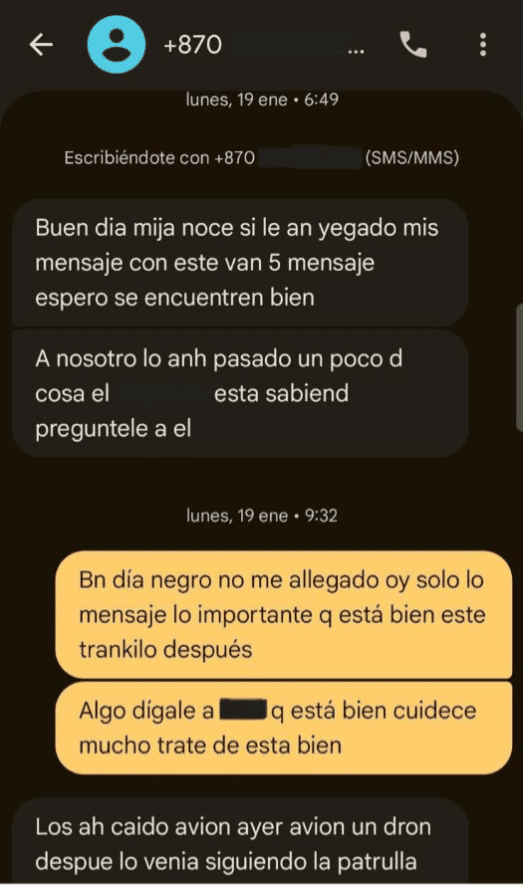
Screenshot of a satellite message sent by Captain Juan Carlos Valencia to his family on January 19, 2026, alerting of the surveillance they were being subjected to by an aircraft, a drone and a patrol boat. Note: Images have been redacted to protect personal identities.
THE MORNING OF JANUARY 20
At daybreak, two skiffs, each with two crew members on board, left the Fiorella to lay several kilometers of spinel with baited hooks, a common task in artisanal fishing. One of the skiffs, the Primer Mandamiento (First Commandment), stayed at a distance of some 15 nautical miles, considerably further from the Fiorella than the other one.
By around 6am, the crew of the Primer Mandamiento had finished laying the spinel and went about their breakfast. Everything was normal until 1pm, when they heard cries of “Captain, Captain, Captain!” from the other skiff on the radio they carried on board. Immediately afterwards, all communication with both vessels was lost.
The crew of the Primer Mandamiento later told the port authority that they had seen a large column of smoke in the distance in the direction of the Fiorella, but were unable to determine with certainty whether it was from a fire on board. The two crew members were the only ones to return from the fishing trip alive. Nothing more has been heard of the Fiorella or the second skiff since.
The boat’s tracking system recorded its last signal at 1:06pm, when it was sailing in international waters, just crossing the maritime corridor separating the Galapagos EEZ from the EEZ of mainland Ecuador.
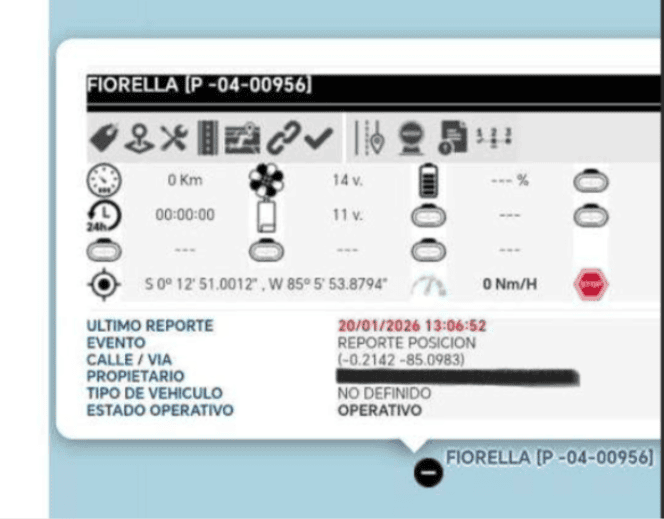
Image of the Fiorella’s satellite tracking system, showing date, time and coordinates of the last signal emitted by the vessel. Note: The image has been redacted to protect personal identities.
After being left adrift, at approximately 6am on January 22, the two crew members of the Primer Mandamiento were rescued by another fishing boat and taken to land.
STATEMENTS FROM RELATIVES AND SUSPICIONS OF DETENTION
Among the families there is a suspicion that their relatives may have been arbitrarily detained and transferred to another country, as was allegedly the case in March with the crews of the Negra Francisca Duarte II and the Don Maca, two boats from a town near Jaramijó. According to the local organization Standing Committee for the Defence of Human Rights, these two fishing boats with 16 and 20 crew members on board were reportedly struck by drones and their crew detained presumably by U.S. personnel two months after the disappearance of the Fiorella, on March 17 and 26, respectively. They were then handed over to the authorities of El Salvador and transferred to that country, before being eventually returned to Ecuador.
“The families of the eight individuals whose whereabouts are unknown fear that this is a case of enforced disappearance at the hands of the United States. The U.S. and Ecuadorian authorities must confirm or deny whether state agents from either country were involved, take all necessary steps to ascertain the fate and whereabouts of the victims, and provide reliable evidence showing what happened to them,” said Ana Piquer, Americas director at Amnesty International.
The response from the Ecuadorian authorities – the only authorities before whom the Fiorella families have submitted a complaint – has been considerably limited. This despite the fact that the UN Committee on Enforced Disappearances (CED) issued urgent actions on behalf of the eight fishermen, calling on Ecuador to immediately search for them and investigate the facts.
Although the port authority claimed to have carried out a search for the vessel and its crew, there are serious doubts as to the extent and effectiveness of such action. According to information provided to the CED by the Ministry of Defense, it was only on January 22, “that the Maritime Rescue Coordination Centre (MRCC) received an emergency alert regarding the disappearance of the vessel”.
Furthermore, it took another day to activate the search and rescue (SAR) plan, and calculations for the search only began on January 24. There is no detailed information on the actions taken to locate the vessel or its crew, and it was the owners of the Fiorella who, using their own resources, sent out another boat on January 26 to try to locate the wreckage. All they found was the spinel.
The families of the missing crew members from the Fiorella claimed that, when they approached the port authority in search of information, they were told by the commander that they should stop looking for [their relatives] because they were dead, and that they should “abide by the consequences”. They took this as an insinuation that their relatives were linked to drug trafficking.
“The commander said to us: ‘You know what they went to do, so why are you looking for them?’ This made me really angry, and I said to him: ‘I’m here to look for my dad, all they did was go fishing. You should show some compassion and tell us the truth.’ The next day we went again [to the port authority] and they simply closed the door on us.”
Statement from the daughter of a fisherman whose whereabouts are unknown.
Although a criminal investigation for involuntary disappearance has been opened at the Manta Prosecutor’s Office, Amnesty International was able to verify, during its visit in June, that the investigations carried out were minimal and did not seem aimed at establishing the facts.
Among the most serious shortcomings is the fact that, more than five months after the events occurred, the Public Prosecutor’s Office had still not submitted a formal request for information to the United States in order to proceed with the investigation, and the administrative file opened by the port authority in connection with the search for the fishermen had not been incorporated into the prosecution’s case file.
“It’s as if the ship simply vanished and no one cares how it happened or what became of the people on board. Perhaps it just flew away? More than six months on from the disappearance, the Ecuadorian authorities must provide a clear account of what actions they have taken to establish the facts, what they know, what they do not know, and how they intend to address the legitimate demands of the families of those disappeared. The criminal investigation into these events must continue until those potentially responsible are identified and brought to justice,” said Ana Piquer.
The investigations have taken place in a climate of increasing violence against justice operators by organized crime in the country. It was in this context that Gloria Alexandra Bravo Cedeño, the prosecutor in charge of the case, was murdered in the city of Manta on June 14.
In addition to this, the families claimed that they felt helpless and distressed not only due to the uncertainty surrounding the fate of their relatives, but also because, in virtually all cases, the disappeared person was also the family breadwinner.
“Cooperation between the United States and Ecuador on issues of security must be based on the protection of human rights and the strengthening of the rule of law. Both countries must review existing bilateral security agreements to ensure they do not contribute to impunity or hinder access to justice for victims and their families,” said Daniel Noroña, Americas advocacy director at Amnesty International USA.
U.S. ACTIONS
Amnesty International has denounced the strikes by the United States against boats in international waters since the country boasted of its first strike on September 2, 2025. The organization considers that these are extrajudicial executions, that is, deliberate and illegal killings under international law.
Despite the request for information made by Amnesty International to the U.S. Southern Command and a meeting held at its embassy in Ecuador, the U.S. has neither confirmed nor denied being responsible for these strikes. Similarly, U.S. members of Congress from a number of committees have requested information from the departments of State, of Defense and of Homeland Security and from the U.S. Coast Guard, demanding a full account of these facts and confirmation of involvement of U.S. security forces or any private entities under their command, with no response having been received to date.
There are indications that the eight individuals whose whereabouts are still unknown would need to be added to the long list of victims of human rights violations by U.S. bombings against vessels and crews in international waters.
However, unlike the more than 60 strikes that have been acknowledged to date, the possible strike against the Fiorella was not announced by either U.S. President Donald Trump or Southern Command, as is usually the case. Nor were the strikes against the Negra Francisca Duarte II and the Don Maca vessels officially acknowledged, despite reports from survivors stating that both vessels were allegedly sunk by unmanned aerial vehicles bearing markings attributed to the United States.
If it were confirmed that the United States was responsible for the strike on the Fiorella, as well as for the strikes against the Negra Francisca Duarte II and the Don Maca, the total number of extrajudicial executions, enforced disappearances and other serious human rights violations associated with these operations could be much higher than previously estimated.
“The Department of Justice and the investigative authorities of the U.S. armed forces must investigate and establish possible criminal responsibility not only in relation to the Fiorella, but also for all other strikes on vessels on the high seas. Similarly, the U.S. Congress must drive a parliamentary inquiry into this serious incident, with hearings and reports designed to establish the facts and determine the possible involvement of public agencies or private entities under its authority. In addition, all states must suspend international cooperation on intelligence and military equipment that could be used in such illegal operations,” concluded Ana Piquer.
Contact: [email protected]