
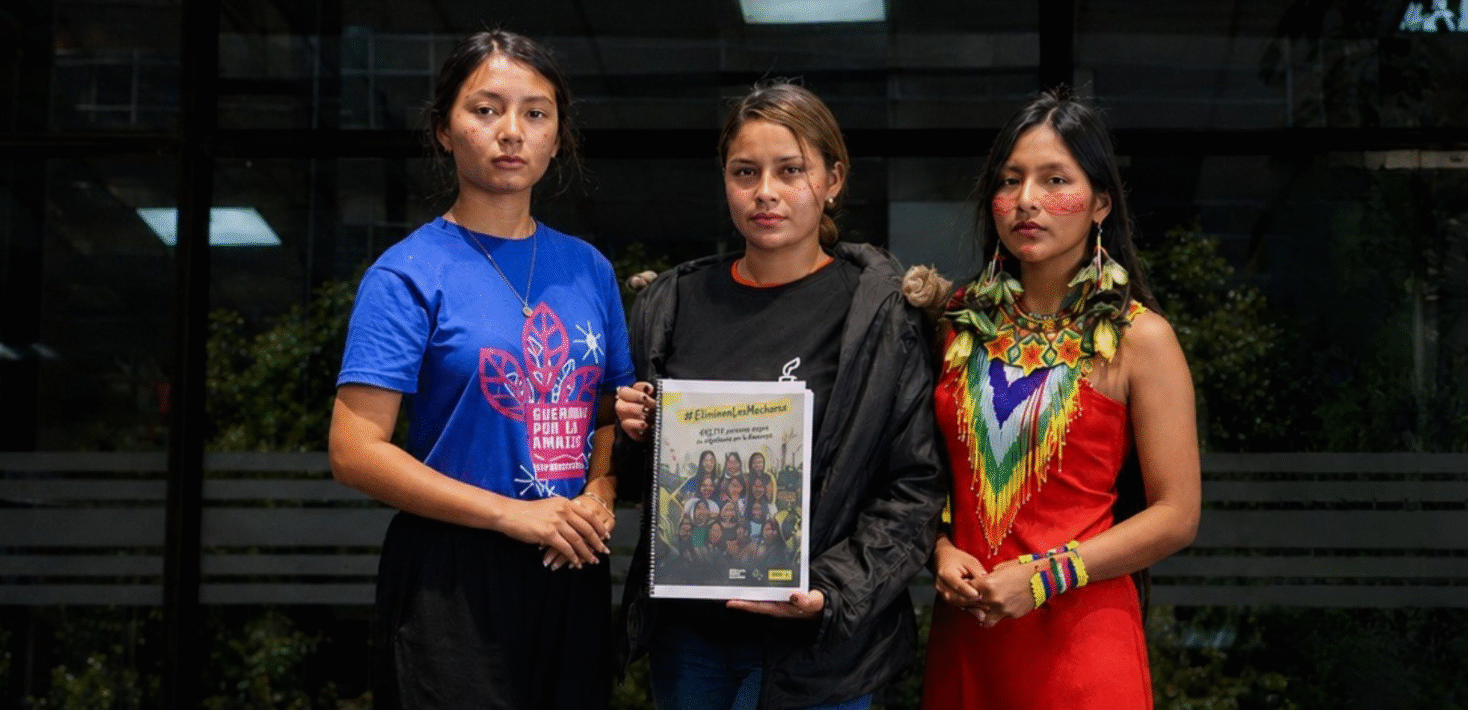
Amnesty International joins the call from the Guerreras por la Amazonía (GxA, Women Warriors for the Amazon), who, five years after securing a landmark ruling requiring Ecuador to eliminate oil industry gas flares located near populated areas and provide reparations to affected communities, continue to demand its full implementation.
“Over the past five years, the Guerreras por la Amazonía, the Union of People Affected by Texaco’s Operations (UDAPT), the Eliminen los Mecheros collective and affected communities have led a tireless struggle for their rights and for climate justice. However, they continue to face the authorities’ indifference, actions that merely create the appearance of compliance with the ruling, as well as stigmatization and even attacks against them,” said Ana Piquer, Americas Director at Amnesty International.
Eliminating gas flares: partial progress and simulated compliance
According to figures from Ecuador’s Ministry of Environment and Energy (MAE), there were 486 gas flares in the Ecuadorian Amazon in 2023. Of these, 424 were operated by the state-owned company Petroecuador and 62 by private companies.
The ruling ordered their progressive elimination by 2030, beginning with those located near populated areas. These flares were supposed to be eliminated within 18 months, a deadline that expired on March 29, 2023.
To comply with this obligation, the MAE issued regulations in 2022 defining as “near populated areas” only those flares located within 100 meters of a cluster of at least 20 adjacent homes.
In its report The Amazon Is Burning, the Future Is Burning, Amnesty International documented in August 2024 at least 52 gas flares located within five kilometers of populated areas—a distance that pollutants can reach.
Despite this, the authorities considered the first deadline to have been met after eliminating only two flares that fell within the restrictive 100-meter criterion.
In July 2026, Petroecuador reported that it had eliminated 183 gas flares and committed USD 600 million to continue the decommissioning process. By the end of 2025, only nine of the 62 flares operated by private companies had been eliminated.
According to the World Bank’s annual satellite monitoring, which tracks global progress towards the goal of zero routine gas flaring by 2030, although the volume of gas flared in Ecuador fell by 9% between 2024 and 2025, it remained 34% higher than in 2021—the year in which the gas-flare elimination program was supposed to begin.
Flourish: Visualization/29830353
Five years later, gas flares continue to affect communities
In July 2026, Amnesty International verified, using World Bank data, official documents and interviews, that at least three gas-flaring sites located within five kilometers of the homes of members of the Guerreras por la Amazonía—and of populated areas more broadly—remain active.
Sixteen-year-old Dayra Shirap is a member of the GxA and belongs to the Indigenous Shuar nationality. She lives almost two kilometres from the Shushufindi South-West Station. According to World Bank data, the volume of gas flared at this site has increased by 53% since 2021.
“Every day when I go to school, I can see it [the gas flare], and it looks like a forest fire,” Dayra said.
She also reported that the flares at the station were switched off only once, during a visit by government ministry officials who had travelled to verify compliance with the ruling. The flares were switched back on after the visit.
Fifteen-year-old Leonela Moncayo, a member of the Guerreras por la Amazonía, used to live with a gas flare directly in front of her home. According to her testimony, the flare was not eliminated. Instead, the pipeline transporting the gas was redirected to another station almost two kilometers from her house.
“They did not eliminate it. They changed the direction of the pipeline, routed it past the entrance to my house and took the gas to the station nearby,” Leonela explained.
The gas was redirected to the Lago Norte Station, where the volume of gas flared doubled between 2024 and 2025, reaching a record high of 7.32 million cubic meters a year. The two flares at the site are included in the progressive elimination plan, but their dismantling is not scheduled to be completed until December 31, 2027.
Eighteen-year-old Jamileth Jurado divides her time between her father’s and mother’s homes. Her father’s home is located approximately 150 meters from an oil platform that is repeatedly affected by spills. Her mother lives in Shushufindi, a city surrounded by gas flares.
Just over four kilometers from her home is the Shushufindi North Station, which, according to World Bank data, records the highest volume of gas flaring in the country: approximately 69.1 million cubic meters a year.
Jamileth also lives approximately 1.6 kilometers from the Shushufindi Central Station, where two gas flares will remain active until the end of 2028, according to a Petroecuador report.
“Living near the gas flares is a daily threat and a constant source of concern. Since I joined the Gas Flares Case, I have learned that this could cause me to develop cancer,” Jamileth said.
Petroecuador’s official plan provides for the elimination of 13 gas flares in 2026, 60 in 2027, 60 in 2028, 50 in 2029 and 54 in 2030.
However, Pablo Fajardo, a lawyer representing the claimants and a member of UDAPT, warned that they have identified new flares and that only a new nationwide study would make it possible to determine clearly how many remain active.
Petroecuador has stated that compliance with the plan depends on operational conditions and the possibility of losses in oil production.
Amnesty International considers that making the elimination of gas flares conditional on the continuity of oil production means prioritizing the economic interests of the oil industry over human rights and maintaining the Ecuadorian Amazon as a “sacrifice zone”. Guerreras por la Amazonía receiving signatures of support from around the world.
Reparations remain outstanding
The ruling also established reparations related to the affected communities’ rights to health, water and a clean, healthy and sustainable environment. Five years later, these measures have still not been implemented.
According to UDAPT, the Ministry of Public Health has not presented the medical and scientific study on the extent of the harm to communities’ health that it was required to deliver within six months of the ruling.
Because the severity of these health impacts has not been determined, the authorities have also failed to establish an Oncology Clinical Unit.
“I feel that I will continue fighting for the rights of the people of the Amazon. I will continue fighting for cancer patients in the Amazon because I know what it is like to experience this suffering first-hand. One day, this will come to an end,” said Jamileth Jurado, the daughter of one of the 749 cancer patients recorded by UDAPT in communities located near gas flares.
The authorities have also failed to properly assess water quality or guarantee access to water that is safe for human consumption.
People living in the area have to use rainwater or groundwater—which is contaminated in many cases—or purchase bottled water.
“We do not have drinking water; we use rainwater. Even when we try to boil it, not all the toxins are removed,” said Leonela Moncayo, a member of the Guerreras por la Amazonía.
Finally, the ruling ordered the establishment of an effective environmental monitoring and verification system to identify violations of the rights of Nature. However, the authorities’ response has been limited to formal written communications.
“They all respond with regulations and reports, but they disguise the situation. They do not provide information about compliance with the ruling, but rather about things that allow them to evade implementing it,” said Pablo Fajardo of UDAPT.
The struggle continues
In response to repeated failures to comply with the ruling, the Guerreras por la Amazonía and UDAPT have sought justice before different bodies, including Ecuador’s National Assembly and Constitutional Court. They have filed two legal actions before the Constitutional Court. One was dismissed and the other remains under consideration.
Although the state has not fully complied with the ruling, according to UDAPT, these five years of struggle and resistance have brought about changes, including greater understanding of the effects of gas flares on the population.
In 2024, Ecuador’s Organic Law for the Comprehensive Planning of the Special Amazonian Territorial District incorporated a provision prohibiting the open-air combustion of so-called “natural” gas through flares when it places communities and ecosystems at risk.
Despite the stigmatization and attacks suffered by the Guerreras por la Amazonía and UDAPT, as well as the lack of state protection measures, the girls and young women have not abandoned their struggle.
In 2024, six girls representing the Shuar, Kichwa, Siona, Siekopai, Waorani and Cofán peoples joined the Guerreras por la Amazonía collective. The Guerreras have also mobilized international solidarity in spaces such as COP30.
In May 2026, the GxA, UDAPT and Amnesty International delivered 492,174 actions of support to the MAE from people around the world calling for implementation of the ruling. Following that meeting, the Ministry committed to promoting inter-institutional technical working groups to make progress on eliminating the gas flares and delivering reparations.
“The Guerreras, UDAPT and the communities living alongside gas flares are not passive victims. Their active resistance is putting pressure on the Ecuadorian state and has become a regional and international example of the struggle for environmental and climate justice. The Ecuadorian state must put an end to simulated compliance and fulfil its obligation to eliminate gas flares and progressively move away from the fossil fuels that are turning the Ecuadorian Amazon into a sacrifice zone,” said Ana Piquer, Americas Director at Amnesty International.
Contact: [email protected]