
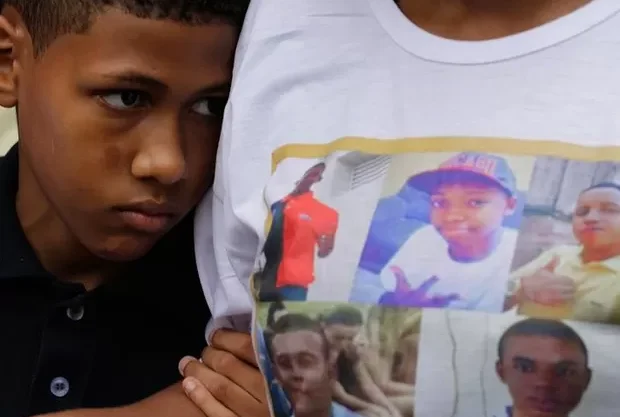
While the world watches humanitarian crises unfold across the globe with deserved urgency, another form of violence wages on in the streets of Brazil. It is a “war” without tanks or missiles, but with a devastating human cost. Its victims are overwhelmingly Black, and for decades, authorities have turned a blind eye. The battlegrounds are the favelas, the peripheries, and other underserved neighborhoods — and, in a good portion of cases, the perpetrators wear official uniforms – the police.
Brazil, home to the largest Afro-descendant population outside of Africa, is in the grip of a racialized public security system that has persisted for centuries. This systemic violence — fueled by historical inequality, racism, and impunity — has produced a pattern of racially targeted lethal violence, especially against Black youth.
The Numbers Don’t Lie
The data paints a horrifying picture:
- Every 12 minutes, a Black person was killed in Brazil in 2024. Source: Atlas da Violência 2024
- More than 5,000 cases of racism and racial slurs were reported to Brazil’s national human rights hotline (Disque 100) just this year. Source: Ministry of Human Rights, 2024
- Around 70% of Brazil’s prison population is Black — a staggering overrepresentation. Source: Anuário Brasileiro de Segurança Pública 2023
- Nearly 73% of people living in under-resourced, high-vulnerability areas in Brazil are Black. Source: IBGE – Brazilian Institute of Geography and Statistics
- Between 2000 and 2021, 90% of racial injury (injúria racial) complaints failed to result in formal indictment — despite legal reforms. Source: Federal Public Ministry (MPF)
These numbers don’t just represent statistics. They represent real lives: sons, daughters, students, workers, artists, and leaders, a generation being extinguished slowly, methodically, and often invisibly to the global public.
State Violence as Policy
The Brazilian police are among the most lethal in the world. In many urban communities, particularly those predominantly Black and low-income, police operations are like militarized invasions. Armored vehicles, helicopters, and high-powered rifles are routinely used in densely populated civilian areas, often during the daytime and without regard for children, elders, or bystanders.
This violence is not a glitch in the system. For many, it is the system.
Brazil’s Legal Framework: Progress on Paper, Failure in Practice
The National Day to Combat Racial Discrimination, which commemorates Brazil’s first anti-racism law, marks an important milestone in legal recognition. Recent changes, like including racial slurs (injúria racial) in the broader Racial Crime Law, reflect progress in theory. But in practice, implementation remains weak — and justice rare. As mentioned, 9 in 10 cases of racial injury complaints between 2000 and 2021 led nowhere.
Legal reforms without accountability mechanisms cannot stop bullets. They cannot repair the trauma or resurrect lives lost to a system that criminalizes Black existence. As seen in the case of the ADPF 635 (ADPF das Favelas), Amnesty International Brazil warns that when court decisions weaken oversight, loosen restrictions on police operations, and normalize militarized tactics, they risk legitimizing the very violence they were meant to curb — leaving Black communities even more exposed to lethal force and systemic impunity.
Emblematic Cases of Racial Violence in Brazil
The ongoing violence towards Black Brazilians is not abstract — it has names, stories, and heartbreak. These emblematic cases reflect the recurring and racialized patterns of state violence, where lives are taken with impunity and entire communities are left traumatized.
These cases also highlight the urgency of campaigns like Jovem Negro Vivo (Young Black Alive) by Amnesty International Brazil, which seeks to call attention to the epidemic of police killings targeting Black youth, as well as the recently launched initiative O Ministério tem que ser Público (The Ministry Must Be Public), which calls for greater oversight and public accountability in police activity across Brazil.
These cases also highlight the urgency of campaigns like Jovem Negro Vivo (Young Black Alive) by Amnesty International Brazil, which seeks to call attention to the epidemic of police killings targeting Black youth, as well as the recently launched initiative O Ministério tem que ser Público (The Ministry Must Be Public), which calls for greater oversight and public accountability in police activity across Brazil.
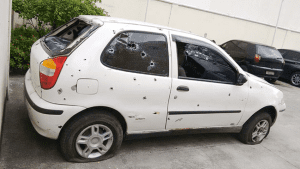
2015 – Costa Barros Massacre, Rio de Janeiro
Five young Black men—Carlos Eduardo, Cleiton, Roberto, Wesley, and Samuel (ages 16 to 25)—were executed inside a car after military police fired 63 bullets at them. Officers claimed it was a mistake, but witnesses confirmed they were unarmed and stationary. In this case, police officers were convicted.
Case spotlighted by Amnesty Brazil’s Jovem Negro Vivo campaign.

2019 – Execution of Evaldo Rosa
Evaldo Rosa dos Santos, a Black musician, was killed when Brazilian Army soldiers fired over 80 bullets into his vehicle during a family outing in Rio de Janeiro. His wife, son, and father-in-law were in the car, and no warning was issued. Luciano, a passerby who tried to help, was also shot and killed. In 2017, a law established that when an Army soldier kills someone during an operation—unlike cases involving the military police—the case is judged by a military court rather than by common justice. This legal change, combined with institutional resistance, meant that even after the case shocked the nation, accountability remained elusive (A Pública, 2024).

2019 – Ágatha Vitória Félix
Ágatha Vitória Félix, an 8-year-old Black girl, was fatally shot in the back while riding in a van with her mother in the Complexo do Alemão favela. The bullet was fired by military police during a night patrol. Authorities initially tried to blame traffickers, but eyewitness accounts and ballistic evidence pointed to the police as responsible.
2021 – Kathlen Romeu
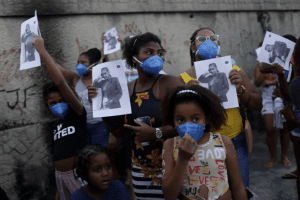
Kathlen Romeu, a 24-year-old pregnant Black woman, was killed by a “stray bullet” during a police operation in a favela in Rio de Janeiro. Her killing sparked national outrage and illustrated how militarized policing endangers everyday life — especially for Black women and mothers. In March 2025, it was decided that the military police officers involved in her death will face a popular jury trial (CNN Brasil, 2025).

2021 – Ryan da Silva Andrade
Only 4 years old, Ryan was playing when he was struck and killed by a stray bullet. The state offered little more than condolences, while his family joined the growing number of Black Brazilians mourning loved ones lost to negligent and racist policing. In 2024, forensic evidence confirmed that the shot that killed Ryan was fired by the military police (O Globo, 2024).

2022 – Genivaldo de Jesus Santos
In a modern-day lynching, Genivaldo, a 38-year-old Black man diagnosed with schizophrenia, was tortured and killed by Federal Highway Police in Sergipe after being stopped for not wearing a helmet. Officers locked him in the back of a police car filled with tear gas, filmed by bystanders in broad daylight. His death echoed the killing of George Floyd in the U.S. The police officers involved were later convicted for the crime (CNN Brasil, 2024).
2025 – Marcelo Barbosa
In one of the most chilling cases of the year, Marcelo Barbosa, a young Black man, was thrown off a bridge after telling police officers he wasn’t a criminal. Witnesses reported that officers mocked him moments before the fatal act. The police officers involved were indicted for the crime (CNN Brasil, 2024). One of them had previously been acquitted under a “self-defense” claim, despite having fired 12 shots during a police approach in Diadema (Terra, 2024). The case has already sparked mass mobilization among human rights groups.
The Global Silence Must End
International human rights observers and institutions must stop treating Brazil’s violence towards Black people as internal or cultural. The silence is a form of complicity.
As the world prepares for COP30 in Belém and celebrates Brazil’s leadership in environmental diplomacy, it must also hold the government accountable for the country’s human rights crisis — one that disproportionately impacts the same Black and Indigenous communities who are on the frontlines of climate protection.
We Need Urgent International Solidarity
International organizations and civil society allies must:
- Demand independent investigations into police killings in Black-majority communities.
- Ensure that Brazil’s Afro-descendant majority is centered in policy, funding, and protection mechanisms.
- Recognize police brutality in Brazil as a form of structural racial violence.
This is not just about statistics. It’s about lives — about a silenced “war” that must be named and stopped. Brazil’s Black youth are not disposable. Their lives matter, their futures matter, and their right to live in dignity and safety matters.
To ignore what is happening is to be complicit.