
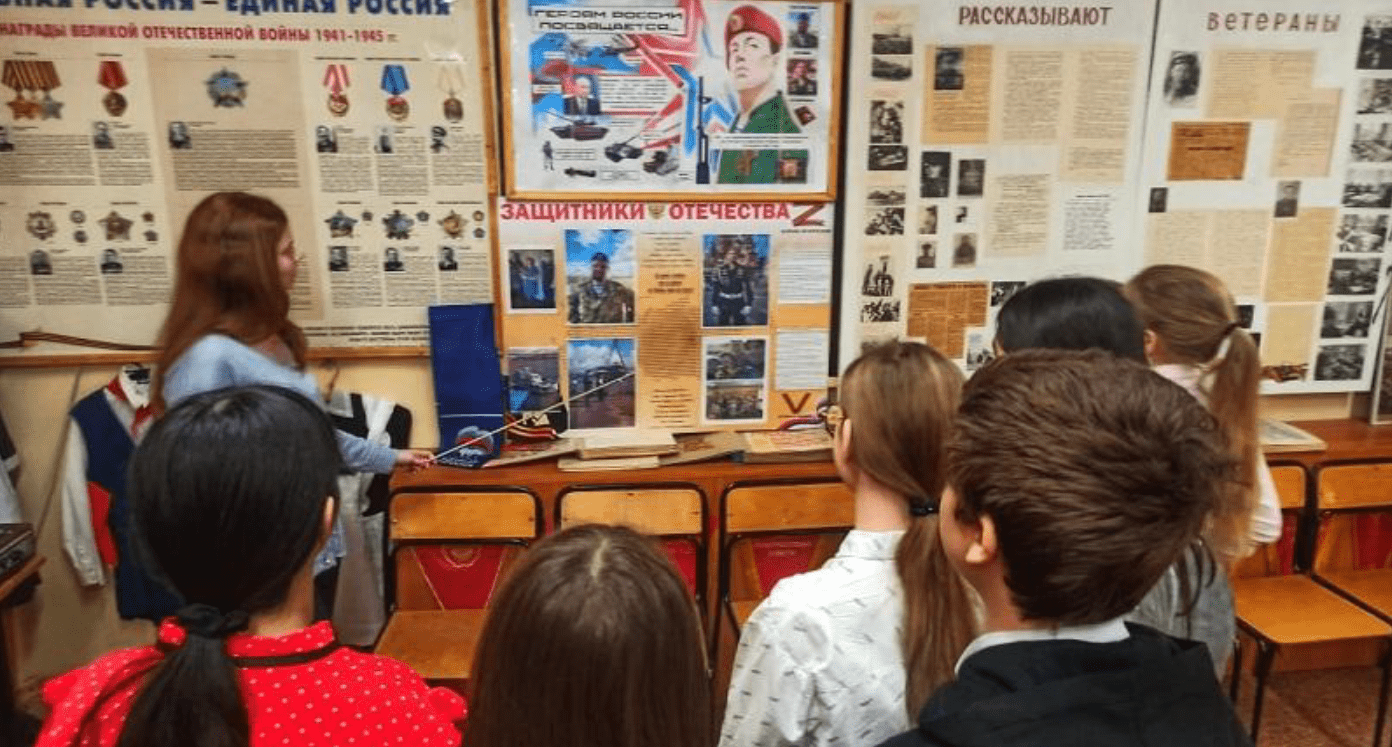
This briefing examines how the Russian authorities manipulate and abuse the educational system, seeking to ensure that the young generation unquestioningly supports all their policies and decisions, including those that expressly contravene Russia’s human rights obligations, encompass military aggression abroad and otherwise defy international order. This practice violates international law, including the UN Charter, the International Covenant on Economic, Social and Cultural Rights, the International Covenant on Civil and Political Rights, and the Convention on the Rights of the Child, which require, amongst other obligations, that education promotes respect for human rights, understanding, tolerance and friendship among all nations.
Amnesty International has analyzed Russia’s evolving legislation, official documents, education materials, internal educational “methodological recommendations,” and other data — all revealing a disturbing picture of schools being converted from temples of knowledge into factories of compliance.
Schools play a dual role for the purpose of indoctrination. On one hand, they are instructed to spread propaganda, often filled with disinformation, that undermines the notion of human rights, whitewashes violations of international humanitarian law in the name of Russia’s national interests, and instructs children to stay away from independent media and other sources of alternative information and opinion. This is done through a centrally controlled curriculum, propaganda-filled history textbooks, special weekly classes and other means such as special lectures justifying Russian aggression against Ukraine.
On the other hand, educational institutions are expected to screen, identify and target those critical of the authorities or having dissenting opinions on a broad range of political and social issues. Schools are encouraged and instructed to monitor their students and even own employees, online as well as offline, to collect files with information about their opinions, sympathies and social contacts and to report unwanted behavior to administrations and law enforcement agencies.
While most of the analysis below is focused on schools, which most Russians typically attend between the ages of six and 17, many of the practices mentioned here apply to older as well as younger ages: to universities, colleges and kindergartens.
These policies, which have been especially actively pursued by the Russian authorities since the full-scale invasion of Ukraine in 2022, violate the human rights to quality education and to privacy and freedom of expression, including freedom of information. They undermine the entire education system. The resulting education system is designed to deny children an opportunity to form their own opinions and learn independent, critical thinking at a formative age. This approach goes against Russia’s international human rights obligations and must stop.
Read “Only Official Sources”: Indoctrination in the Russian Educational System.