
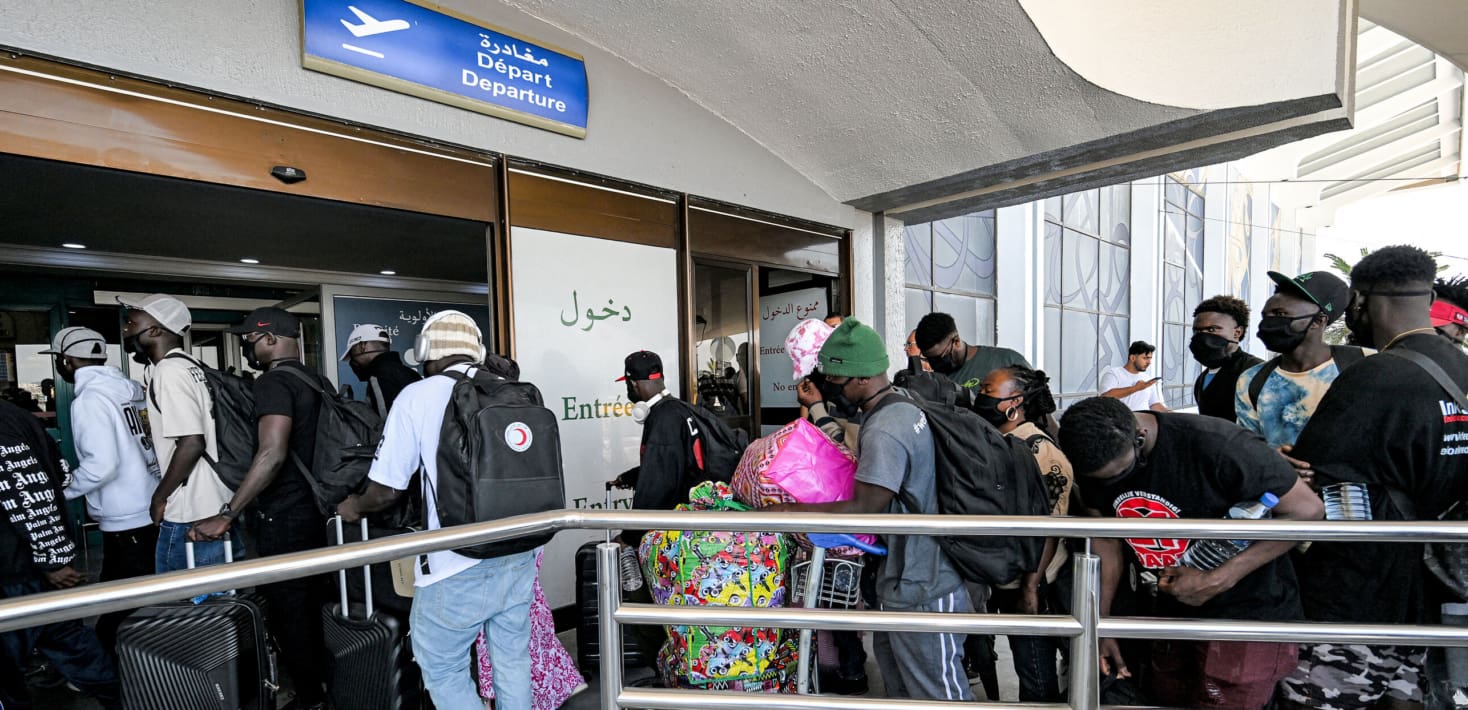
Tunisian authorities must immediately overturn racist and xenophobic policies that have systematically excluded refugees and asylum seekers from protection, restore access to asylum procedures, halt unlawful collective expulsions and other forced returns, and stop repressing civil society organizations assisting refugees and asylum seekers, Amnesty International said today.
Since 2023, the Tunisian government has subjected refugees and asylum seekers, particularly Black people, to pervasive and serious human rights violations as part of a policy of racialized exclusion. Fueled by inflammatory rhetoric from officials, Tunisian authorities have carried out discriminatory arrests and detentions and collective expulsions of tens of thousands of people who are also subjected to torture and other ill-treatment.
The crisis escalated in June 2024, when authorities ordered the UN Refugee Agency (UNHCR) to suspend asylum registrations and refugee status determinations. This decision, which was not publicly communicated, has left thousands of marginalized people at further risk of human rights violations and abuse. This has taken place in the context of the EU’s externalization policy, through which it has stepped up support for Tunisia over migration control in an effort to deter migration to Europe despite mounting evidence of human rights violations.
“Refugees and asylum seekers in Tunisia are being deliberately trapped in a system that offers neither protection nor a safe way out,” Sara Hashash, Deputy Regional Director for the Middle East and North Africa said.
“Tunisian authorities must backtrack from this shameful policy of racist exclusion and abuse that disproportionately affects Black people and step away from EU externalization cooperation which aims at outsourcing irregular migration controls and keeping foreign nationals outside European borders at all costs. They must immediately restore access to asylum procedures and ensure refugees and asylum seekers are protected without discrimination.”
Since February 2026, Amnesty International spoke to 24 asylum seekers and one registered refugee including 11 women and one child from Afghanistan, Algeria, Cameroon, Central African Republic, Guinea, Libya, Sierra Leone and Sudan, identified in large part through the network of Refugees in Libya, a collective also including refugees and migrants in Tunisia.
Valentin, a registered refugee from Cameroon who was eventually able to leave for France in April 2026, was detained in Tunis between March and June 2025, with authorities refusing to recognize his refugee card and provide access to UNHCR, convicting him for entering Tunisia “illegally”.
Two Sierra Leonean asylum seekers were detained by police in August 2025 in Tunis, resulting in their separation from their two children for two months. At least three women asylum seekers from Guinea and Sierra Leone, were still detained with their four children in the Ouardia Reception and Orientation Center (‘Ouardia center’) in Tunis at the time of writing, after police arrested them while begging in Djerba in May 2026. Tunisian authorities have used the Ouardia center as an administrative detention facility to unlawfully detain refugees and migrants indefinitely, without giving them the chance to challenge their detention, often before returning them to their country of origin or to another country.
Amnesty International spoke to 12 asylum seekers collectively expelled to the Algerian or Libyan borders since June 2024 following their arbitrary arrest or interception at sea. In April 2026, Tunis police arrested Abdul, a 13-year-old Sierra Leonean boy and his family while they were begging for food, drove them to the Libyan border, and handed them over to an armed Libyan group who held them for ransom. They were released after three weeks when friends helped them pay the ransom.
Amin, an asylum seeker from Afghanistan who could not register with UNHCR after 2024, was forcibly returned to Kabul on 6 March 2026 after being arbitrarily detained in a Tunis prison then in the Ouardia center for two months.
All 12 people collectively expelled recounted horrific accounts of torture and ill-treatment by the police and National Guard. Victims, including Abdul, reported being beaten with batons, kicked, sprayed with chemical irritants, subjected to electric shocks and sexual abuse, and forced to undergo abusive naked searches constituting rape.
Isatu, an asylum seeker from Guinea, told Amnesty International that, after her arrest in Tunis in February 2025, the National Guard expelled her to Libya with at least 15 other women. She said: “At the border, they made us strip naked outside, all together, and searched us… A male agent searched me inside between my legs even though I told him I had nothing.”
Detained by an armed group in Libya for a year she said she was repeatedly raped because she could not pay a ransom.
The situation on the ground has severely deteriorated with officials and parliamentarians openly advocating for racial and xenophobic hatred in the aftermath of President Kais Said’s racist speech in February 2023, as recently as April 2026.
This rhetoric, combined with impunity for the racist violence it has triggered, has made daily life impossible for refugees and migrants, particularly Black people. Landlords and employers face threats of criminal sanctions for hosting or hiring irregular migrants, leaving families under the constant fear of forcible evictions, police raids or racist violence from citizens, forcing many to live on the streets. Simultaneously, the authorities’ criminalization of civil society work since 2024 has forced most independent organizations providing medical assistance, legal aid, and emergency housing to suspend their operations. The few remaining groups have had to adapt or reduce their work to protect themselves and their beneficiaries from arrest.
Sixteen asylum seekers interviewed by Amnesty International had previously lived on the streets or in rough housing for up to a year or were still living on the streets, including with their young children. Twelve of them were currently facing imminent eviction from their landlords. Three women told Amnesty International that they felt forced to have sexual relations with Tunisian men in exchange of money to support their families due to their inability to find other sources of income.
Grace, an asylum seeker from Guinea living in Tunis with her two children, told Amnesty International that police arrested her husband in January 2026 and expelled him Libya with a group of other Black people. Left without any income, police have since arrested her three time while begging and confiscated the money she had collected.
She said: “Every time they find me, the police take my money… I need to feed my children… I have had to sleep with Tunisian men in exchange for money… If I had a safe family, I would return to my country, but I can’t.”
In such conditions, returns – including organized by the Tunisian government since June 2025 – have constituted constructive refoulement, meaning people’s lives are made so difficult that they feel compelled to leave the country even if it means returning to a situation they fear.
For asylum seekers with irregular status, leaving Tunisia safely has become virtually impossible following the UNHCR suspension. Resettlement opportunities are extremely limited, while Tunisian law offers very limited pathways to regularize irregular status. Many are further trapped after authorities confiscate their identity documents during arrests.
Background
Despite having ratified the 1951 Refugee Convention, Tunisia has never established a national asylum system, choosing instead to delegate all registration responsibilities to the UNHCR. The devastating impact of the suspension of UNHCR registration is clear: as of April 2026, only 7,515 individuals remained registered with the UNHCR, a staggering drop from the 18,362 registered in June 2024. The vast majority of those registered and left abandoned have fled armed conflict and widespread violence in Sudan, Syria, and Somalia.
Contact: [email protected]