Visitors to Saudi Arabia, including those traveling for tourism and religious pilgrimages such as Hajj and Umrah, risk being detained, subjected to grossly unfair trials, and sentenced to lengthy prison sentences for their social media activity – including posts published before entering the Kingdom, Amnesty International and ALQST said today.
Amnesty International and ALQST have documented the cases of eight people, predominantly from Global South and Middle Eastern countries of origin, who were arrested in Saudi Arabia during visits between July 2022 and late 2025 for their social media posts. Three of the eight were visiting for Hajj or Umrah; the other five for tourism or family trips.
Saudi authorities detained some visitors shortly after they arrived in the country, others during their stay and others while attempting to exit the country. In the documented cases, Saudi authorities interrogated visitors about social media posts they had published, and subjected them to prolonged arbitrary detention, grossly unfair trials or delayed access to consular support. In one case, Saudi authorities prevented those detained from sharing information with their relatives abroad.
“As Saudi Arabia positions itself as an international tourism destination and invests heavily in tourism as part of its Vision 2030 plan, it is simultaneously arresting and sentencing visitors to the Kingdom to lengthy prison terms simply for exercising their right to freedom of expression. Individuals travelling to Saudi Arabia to undertake once-in-a-lifetime religious pilgrimage journeys or to visit their loved ones are suddenly thrust into a nightmare scenario – without warning – torn apart from their families and all of this just for social media posts,” said Bissan Fakih, MENA Campaigner at Amnesty International.
“The Saudi authorities’ long-standing suppression of the free speech of their own citizens and residents is now being extended to foreign visitors. Behind the Saudi government’s carefully curated image of being open to the world lies a prevailing climate of fear, maintained by severe repression inside the country” said Nadyeen Abdulaziz, Monitoring and Advocacy Officer at ALQST.
Amnesty International and ALQST call on states to pressure Saudi Arabia to end its crackdown on freedom of expression against both visitors and residents and to immediately release those held for exercising their right to freedom of expression. Foreign ministries should also ensure their travel advice for Saudi Arabia is updated so that travelers are aware of the risks posed by their social media activity should they visit the country, especially as it attracts more tourists to the country and gears up to host Expo 2030 and the World Cup in 2034.
Saudi Arabia has set a goal of 150 million tourists by 2030 as part of its flagship Vision 2030 program aimed at diversifying Saudi Arabia’s economy, fostering a “vibrant” society and positioning the Kingdom as a global destination. Yet, Saudi Arabia maintains an extremely restrictive legislative environment that criminalizes and imposes severe penalties on expression protected under international human rights law. Saudi Arabia’s counter-terror court, the Specialized Criminal Court (SCC), has routinely used vague provisions under the anti-cybercrime and counter-terror laws equating permissible expression with “terrorism.”
Social media arrests, prolonged pretrial detention and grossly unfair trials
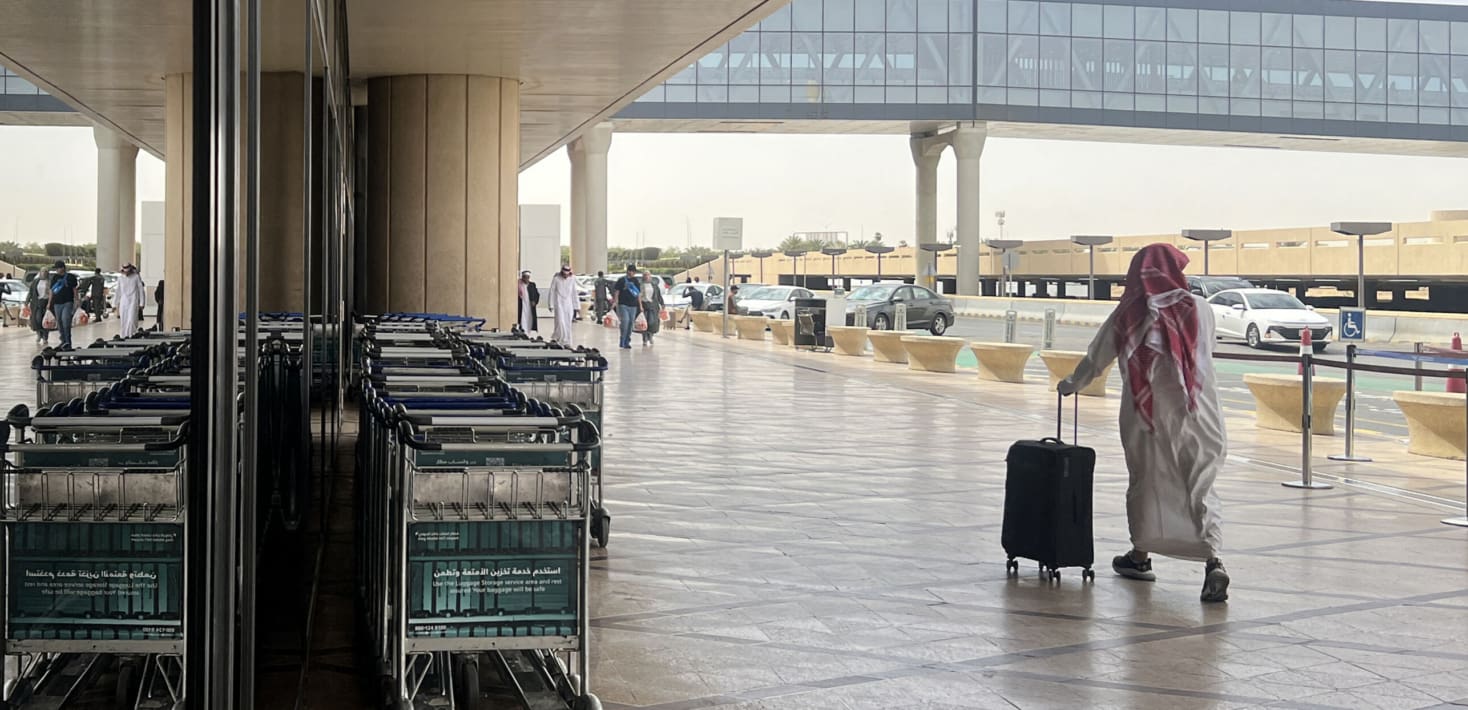
British national Ahmed al-Doush is serving five years in prison after an unfair trial for charges based on social media use, in violation of his right to free expression. Saudi authorities arrested al-Doush, then a senior business analyst with Bank of America, on August 31, 2024 at the airport in Riyadh as he was returning to the UK after visiting Saudi Arabia with his pregnant wife and two children, because of social media posts he published before arriving in Saudi Arabia. The Specialized Criminal Court (SCC), sentenced him to 10 years in prison on May 12, 2025, shortened to five years on appeal in April 2026. Saudi authorities have not shared court documents, including the trial and appeal judgments, with his family or UK lawyer, despite repeated requests.
Those detained faced multiple due process and detention-related violations. In some cases, detainees who didn’t understand Arabic were forced to sign documents written in Arabic without understanding their contents. Some who were eventually released reported not being provided with adequate clothing or personal belongings. For at least one of the foreigners whose cases were documented by Amnesty International and ALQST, Saudi authorities restricted contact with their family members based abroad.
Ahmed al-Doush’s communication with his family has been severely restricted. He told his wife in April 2025 that he was instructed by prison authorities to only check in on her and the children during the calls, and that if he discussed anything about his conditions of detention, health or legal proceedings and charges against him, that the call would be terminated and there would be punishment. His family reported that he was recently denied contact with them for almost three weeks because he spoke to his children in English. His well-being and mental health has deteriorated significantly while in prison.
Similarly, Saudi authorities arrested Dutch-Yemeni national Fahd Ramadhan on November 20, 2023 and held him in arbitrary detention for 18 months. Ramadhan was never formally charged, but told officials from the Dutch embassy in Riyadh that he believed the reason for his detention was online posts in which he sympathized with a critic of the Saudi royal family. Interrogators had asked him to sign a document listing four of his posts on X during pretrial detention. He was released in June 2025.
Another individual, whose name has been withheld for security reasons, was arrested in Mecca while performing the Umrah pilgrimage, just four hours after sharing a post on social media criticizing the Saudi authorities, which he had deleted two hours later. He was detained for one year and eight months without trial and has since been released.
In 2023, Saudi authorities arrested another individual performing the Umrah pilgrimage for holding up a small piece of paper calling for the release of a political prisoner held in another country, unrelated to Saudi Arabia, and detained him for a year. Saudi Arabia released the person nearly a year later.
Haidar Slim, a Lebanese national, was detained in 2022 after performing Hajj. He filmed himself chanting a Shia religious chant during Hajj, which later circulated online. He was subsequently prosecuted under the Cybercrime Law for “publishing content that undermines public order and religious values” and sentenced to five years’ imprisonment and a fine of 10,000 SAR. He was released in March 2025 after serving nearly three years of his sentence, following diplomatic intervention.
Amid the prevailing fear and lack of transparency in the country, the true scale of such expression-related arrests is likely greater, with some information only emerging after detainees are released and able to leave the country.
In addition to the eight documented cases, which include a US national detained for two months without charge in late 2025 after posting a TikTok video about his experiences in the country, and a Canadian national arrested in April 2023 and interrogated over social media posts and “likes,” Amnesty International and ALQST are aware of a number of additional cases of tourists being arrested while in Saudi Arabia for social media activity, including some whose cases the organizations have not been able to investigate.
Cases reported in the media include that of a man detained during Hajj after criticizing Saudi authorities’ alleged neglect after 1,301 pilgrims died during Hajj in 2024, which the Saudi Ministry of Health later said was mostly due to heat stress.
“Foreign governments should use the means available to them to protect the rights of their citizens and residents while abroad, including providing consular assistance and monitoring trial proceedings. Governments that profess to believe in universal human rights should advocate for the release of all those arbitrarily detained for exercising their right to freedom of expression,” said Nadyeen Abdulaziz.
Updated on July 17, 2026: An earlier version of this press release incorrectly referenced the case of an individual who was detained partly for exercising their right to freedom of expression verbally, rather than through a social media post. This case has now been removed and the total number of documented cases has been changed from nine to eight.
Background
Amnesty International and ALQST have documented dozens of cases of Saudi nationals detained for their social media posts, including Red Crescent worker Abdulrahman al-Sadhan, serving a 20-year prison sentence and currently forcibly disappeared after posting satirical posts on X, and fitness influencer and woman human rights defender Manahel al-Otaibi who is serving a 5-year prison sentence for tweeting in support of women’s rights including under the hashtag #EndMaleGuardianship, and posting a photo of herself online in a shopping center not wearing an abaya (traditional dress).
Amnesty International has also found that authorities across Gulf states, including Saudi Arabia, have intensified a clampdown on the right to freedom of expression after the US-Israeli war with Iran.
Contact: [email protected]