
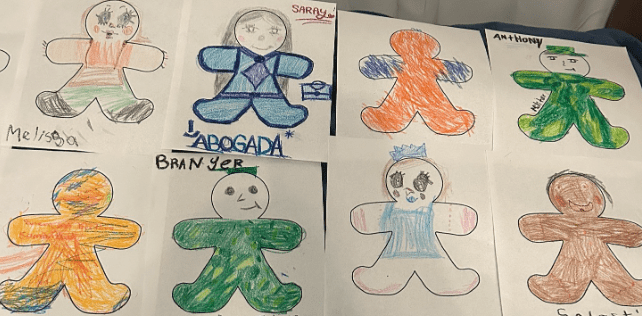
As the U.S. government under the Trump administration continues its attacks on immigrant communities, the National Coalition to End Family and Child Detention this week launched Paper Dolls to Free Families, a campaign to bring awareness to the cruel practice of family detention and to demand that lawmakers stop jailing immigrant children and their families.
Family detention has received a swell of backlash in recent weeks after the jailing of five-year-old Liam Conejo Ramos, who was released with his father from the Dilley Family Detention Center in January. Children and parents detained in Dilley are now facing a highly contagious measles outbreak.
Paper Dolls to Free Families is a national campaign inviting people from across the country, including educators and students, religious and community groups, and even children currently detained by ICE, to create paper dolls with messages and colors of hope, solidarity, and love.
As part of the Trump administration’s broader attacks on immigrant communities, including militarized enforcement, mass deportations, and increased surveillance, ICE resumed the cruel practice of family detention in 2025.
Together with the Coalition, individuals across the country are calling for an end to family detention and will deliver the paper dolls to their members of Congress in March. The delivery urges Congress to end the practice of family detention by cutting off funding and passing legislation such as the Dignity for Detained Immigrants Act.
Family detention is inhumane and unnecessary. While detention is harmful for everyone, it is particularly traumatizing for children, with lasting harms that persist long after release, including developmental delays, anxiety, depression, post-traumatic stress disorder, and suicidal ideation. Families in detention often lack access to adequate clean drinking water and nutritious food, and children sometimes experience dangerous weight loss. Inadequate access to medical care during prolonged detention also poses serious health risks, with chronic conditions, acute illnesses, and injuries being overlooked or ignored.
With this campaign, people across the country are saying that families belong together. No family should be separated, detained, deported, or disappeared. These practices do not align with the core values many of us hold dear: freedom, fairness, and protecting children.
The coalition is urging Congress to support the creation of an immigration system that protects children, keeps families together, and helps all of our communities thrive. Now more than ever, as families across the country are being torn apart and locked up in horrific conditions, it is urgent to build an immigration system based on human rights and dignity.
Statements from members of the National Coalition to End Family and Child Detention:
“The paper dolls campaign is an expression of Americans’ grief, anger, and deep concern about ICE’s cruel treatment of children and their parents in detention, and it sends a clear message to Congress that their constituents expect them to take swift action to free these families,” said Trudy Taylor Smith, senior administrator of Policy and Advocacy, Children’s Defense Fund-Texas. “No child should ever be detained. Immigration detention is always inhumane, and the measles outbreak inside the immigration prison in Dilley only adds to the risks children and their parents are already subjected to while being detained, including extreme stress, hunger, poor nutrition, medical neglect, and unsanitary conditions. ICE has consistently failed to provide safe conditions or adequate health care for families in detention. The only humane response to the current crisis is to release families from Dilley, close this dangerous facility, and end the policy of family detention once and for all.”
“Detaining immigrants, including families and children, is a cruel and inhumane practice,” said Diego De La Torre, Refugee and Migrant Rights Fellow with Amnesty International USA. “No family should ever be detained. This dehumanizing policy does nothing to make our communities safer, but it does inflict lasting trauma, especially on children, that can follow them for the rest of their lives. As the Trump administration advances its racist, anti-immigrant agenda rooted in fear and chaos, we must reject policies that dehumanize and inflict suffering on our immigrant families, friends and neighbors. Through this campaign, people across the country are coming together to support families inside of Dilley and demand an end to family detention.”
“Children are among the most vulnerable members of our community. Leaving them in family detention while conditions worsen and their physical and mental health decline, goes against the values we claim to uphold,” said Hortencia Rodriguez, director of community partnerships with the Acacia Center for Justice. “Caring for children is not political. Their safety and futures are at risk as we continue this cruel practice. We all carry the responsibility of doing right by Liam Conejo Ramos, and the many children like him who are still locked up, to urgently bring an end to family detention now and forever.”
Background
President Obama ended family detention at the Hutto Detention Center in Texas in his first year in office, only to bring large-scale family detention back in 2014. By the end of 2014, the Karnes Residential Center in Karnes City, Texas (Karnes) and the South Texas Family Residential Center in Dilley, Texas (Dilley) had opened and a fourth facility, the Artesia Family Residential Center in New Mexico, had both opened and closed amongst a firestorm of criticism. With Berks, Karnes, and Dilley all detaining families, the family detention program in the U.S. became the largest since the incarceration of Japanese Americans in the 1940s, with a combined capacity to jail over 3,000 people.
Obama’s policy of family detention paved the way for the expansion of family detention by the first Trump administration. President Biden promised to end family detention on the campaign trail and repeatedly condemned the Trump administration for detaining families. In December 2021 the Biden administration stopped detaining families at Berks, Karnes, and Dilley until the Trump administration brought the policy back in March of 2025, reopening Karnes and Dilley.
Contact: [email protected]