
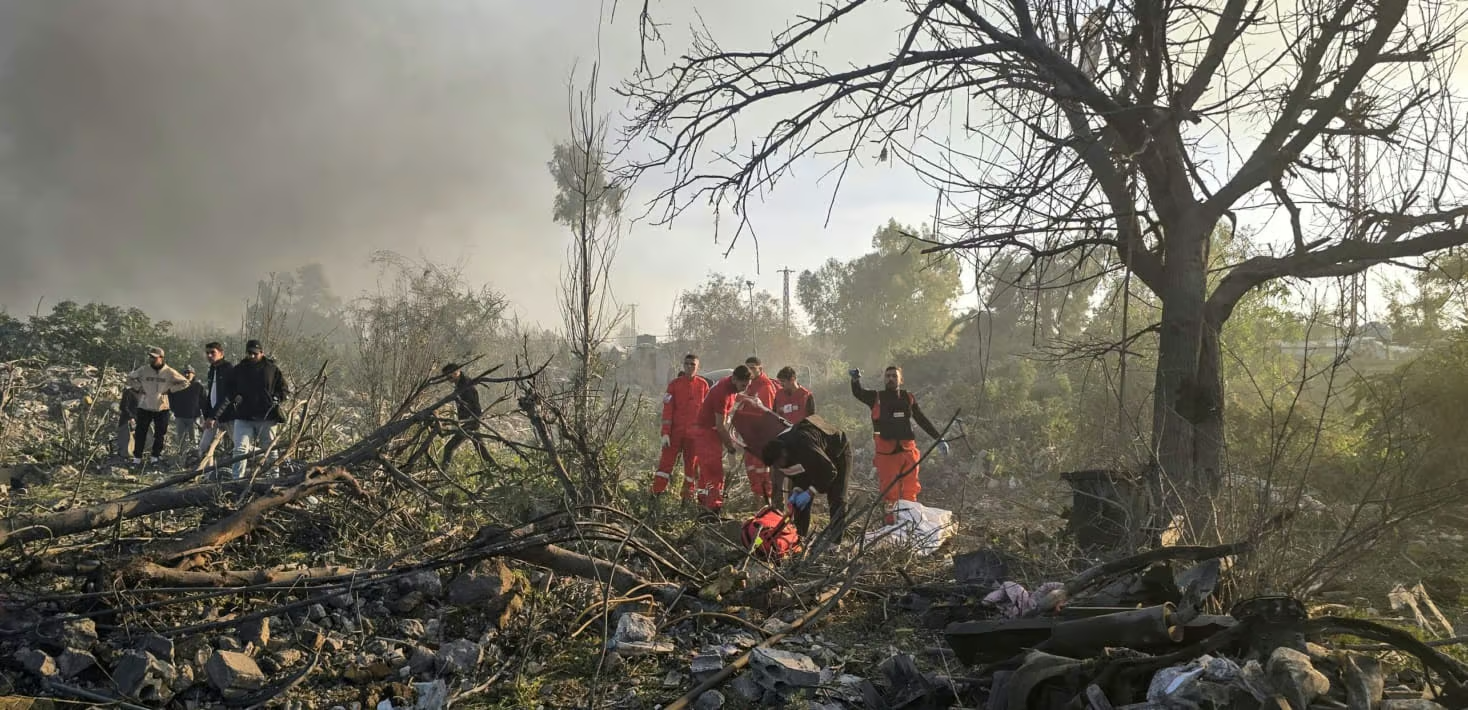
Three Israeli air strikes in southern Lebanon in March 2026 that killed 24 civilians – 12 of them children – wiping out families, must be investigated as war crimes, Amnesty International said today.
The organization investigated three Israeli attacks that destroyed civilian homes in al-Thakana neighborhood in Tyre district, Irkay village in Saida district, and al-Rahbat neighborhood in Nabatieh district on March 6, 12, and 13, respectively. Those killed included 12 children, ranging in ages from five to 16, six women – including a pregnant woman – and six men. At least 18 others were also injured.
Based on the evidence gathered, in each of these air strikes, Amnesty International has reasonable basis to conclude that Israeli forces violated international humanitarian law, including by failing to distinguish between civilians and military objectives, by carrying out attacks directed against civilians or civilian objects, or by failing to take all feasible precautions to minimize harm to civilians.
“Within the space of just a week, the Israeli military obliterated entire families, including a dozen children, in Lebanon, demonstrating a callous disregard for civilian lives. How many more families will have to pull the body parts of their children from the rubble before this devastating cycle of war crimes ends? The international community must act now: states must impose an immediate comprehensive arms embargo on Israel and use universal and extraterritorial jurisdiction to investigate and prosecute those responsible,” said Kristine Beckerle, Deputy Regional Director for the Middle East and North Africa at Amnesty International.
“There are mounting fears that the latest, U.S.-brokered Israel-Lebanon agreement could become yet another barrier to justice, denying victims a path to accountability. The harrowing testimonies shared by survivors and witnesses of these attacks offer a chilling glimpse of what complete impunity for unlawful Israeli attacks means in practice.
“The Lebanese authorities must act decisively by granting the International Criminal Court jurisdiction over crimes on their territory and by supporting international justice efforts and initiating credible, independent domestic investigations into crimes under international law. Without coordinated action — domestically and internationally — the cycle of war crimes and impunity will continue with no end in sight.”
Between March 2, when the conflict escalated, and June 29, 4,257 people were killed in Lebanon, including more than 250 children according to the Lebanese government. At least two civilians were killed in Israel and at least 39 soldiers in southern Lebanon, according to Israeli media reports.
Amnesty International interviewed 15 people, including survivors, relatives, paramedics, journalists who visited attack sites, and local officials for this investigation. Amnesty International’s Crisis Evidence Lab analyzed satellite imagery and verified 20 photos and 11 videos shared directly by sources or published on social media. Researchers also reviewed Israeli and Lebanese social media to understand the context in which each strike happened and to look for evidence of any possible connections with Hezbollah among the victims.
Amnesty International wrote to the Israeli authorities on June 12 requesting information on nine attacks in Lebanon, including these three attacks, seeking clarification about the military objectives targeted and the measures taken to avoid, minimize, investigate or repair civilian harm. In their response on June 22, Israeli authorities stated that they had “reviewed the allegations submitted,” that some “were carried out against Hezbollah military objectives,” while others were “referred for examination.” They stated that they are “committed to mitigating harm to civilians during operational activity” and that Hezbollah “systematically exploits civilian infrastructure for military purposes.” Despite follow-up, the Israeli military did not provide specific information regarding the three attacks documented below, including what the targets may have been.
International humanitarian law requires parties to distinguish at all times between military objectives and civilians or civilian objects, and to direct their attacks only at military objectives. In addition to prohibiting direct attacks on civilians or civilian objects, international humanitarian law prohibits indiscriminate attacks that fail to distinguish between military objectives and civilians or civilian objects. Parties to a conflict must also ensure to spare civilians and civilian objects, including by taking all feasible precautions to minimize incidental harm to civilians and damage to civilian objects. This includes doing everything feasible to verify that targets are military objectives, and to halt attacks if it becomes apparent that they are wrongly directed or disproportionate.
‘I spent three days collecting body parts’
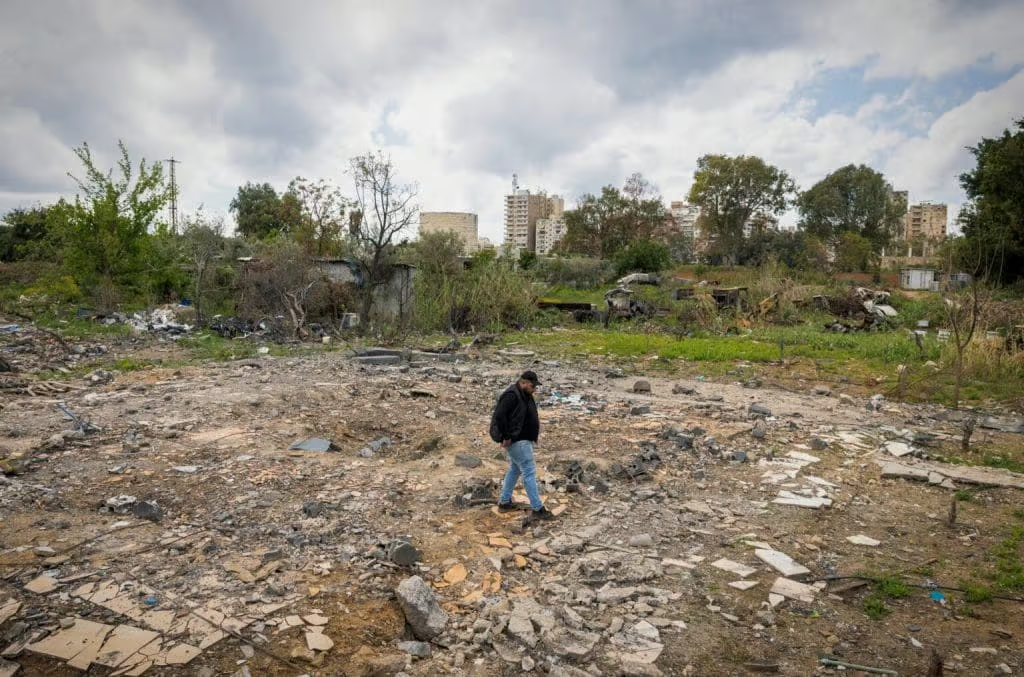
On March 6, at approximately 3:50 pm local time, an Israeli airstrike hit the house of Hassan Saleh in al-Thakana neighborhood in Tyre district on the southern coast of Lebanon. The strike destroyed the house and killed eight family members, all civilians, including three children, who were present. The strike also injured an additional six civilians, three seriously, including extended family members and one migrant domestic worker, in a nearby house.
The strike, which was carried out without warning, killed Hassan Saleh – a retired man in his sixties who had been receiving cancer treatment – his wife Fatimah Saleh, and their two children: Zein al-Abidin, 14, and Roqaya, 11. The strike also killed Fatimah’s sister, Haniya, who was three months pregnant, and her five-year-old daughter Sara. Fatimah and Haniya’s two aunts, Khadija and Samira, were also killed.
Hussein Saleh, the only surviving family member, was not home at the time of the attack. He told Amnesty International that he, his wife Haniya and his daughter, Sara, had sought refuge in the family house because they assumed it was safe. People living in the family house had not received a warning call to evacuate as many other houses in the area where he lived in Tyre had.
A day earlier, on March 5, the Israeli military had issued sweeping mass “evacuation” orders telling all residents of southern Lebanon, including residents of Tyre city, to leave – to “ensure [their] safety.” According to the order anyone who moved south “put [their] lives at risk.” Hussein said his family were not able to immediately evacuate Tyre city because six of his family members were living with a medical condition or suffered from an illness.
Such mass evacuation orders, which are overly broad and lack clear information on safe routes, destinations, time frames for attacks and how to move away from military objectives that are going to be struck, do not constitute effective advance warnings. Issuing them does not grant the Israeli military the right to treat these areas as open-fire zones, nor does it absolve Israel of its obligations to abide by international humanitarian law; to distinguish between military and civilian targets and take all feasible precautions to minimize harm to civilians.
Hussein had gone to the market to get groceries ahead of Iftar when the attack happened. He rushed back towards his family home after he heard the strike and saw where the smoke was coming from. He described the scene upon his arrival:
“There was no trace left of the house, no walls, no blocks and the body parts were scattered on the ground… I spent three days collecting body parts (…) There was no military target whatsoever. All were women and children… They destroyed my whole life. Why didn’t they give us a warning? (…) Sara, my daughter, meant the world to me.”
Amnesty’s Evidence Lab verified two videos shared by witnesses. One of them showed first responders carrying a body bag amid the rubble and another one showed the empty lot where the family home used to stand. One picture published by the media shows a crater at the location. Satellite imagery analysis confirms the building was destroyed between the mornings of March 6 and 8, 2026. Both the crater and damage visible are consistent with an air strike.

Amnesty International’s research did not find evidence that there were military objectives present at the time of the attack. Paramedic, Moussa Chaalan, who was among the first to arrive at the site after the attack, said:
“This is a civilian neighborhood (…) there was nothing left of the house. The body parts were scattered as far as 200 meters away from the impact site.”
A local official also said the Saleh family were civilians, that the area targeted was a civilian neighborhood, and that there were no military activity or military objectives present in the area.
The strike destroyed a civilian home and killed eight civilians, including four women and three children, without warning. Based on the evidence, Amnesty International has reasonable basis to conclude that this attack was either a direct attack on civilians or a civilian object or an indiscriminate attack and must be investigated as a war crime.
Aside from issuing a mass evacuation order the day before the attack, Israeli authorities have not confirmed or denied that they carried out this attack nor published any statements providing an explanation. In their responses to Amnesty International, the Israeli authorities said the “allegations have been referred for examination”.
‘Four daughters killed’
On March 12, at around 2:20pm, an Israeli airstrike on Irkay village in Saida district, which marks the entrance to southern Lebanon, destroyed the house of Rida Taqi, killing seven civilian family members, including four children, and injuring five other family members, including a child. The strike, carried out without warning, also damaged the adjacent house of Rida Taqi’s daughter, killing her husband and her 12-year-old son, and injuring her and her brother-in-law, all civilians.
Mohamad Taqi, 54, who survived the attack, lost his four daughters Zeinab, 14, Zahraa, 12, Malika, nine and Yasmina, six. The strike also killed his mother, Zeinab Nasser, 78, his father, Rida Taqi, 83, and his brother Ahmad Taqi, 52.
Mohamad Taqi works at the Port of Beirut and runs their family’s cattle farm with his brother Ahmad in Irkay village. After the war escalated, he moved with his family to his father’s house assuming that it would be safer because it was in the center of the village.
At the time of attack, Mohamad was on the porch with family members, while his four daughters, their 11-year-old cousin and their grandmother (Mohamad’s mother) were inside the house.
After the attack, as soon as he was able to move, he said, he started looking for his family members under the rubble:
“When I was able to stand up, I started looking for the girls and my parents (…) I found Yasmina. She still had life in her. Her breathing was slow. The paramedics pulled her to the hospital. Malika had no life left in her. The paramedics also pulled her [out].
“In the bedroom where the missile hit, I couldn’t find a trace of Zeinab and Zahraa. The paramedics later found their body parts and they gathered them. When I lost hope of finding them alive, I went to the hospital. I was injured in my head, eye, and face.”
Local paramedic Mohamad Chakaroun said that as soon as his team realized that the air strike had hit the center of the village, they knew that there would be a high number of civilian casualties. They arrived on the scene about five minutes after the strike:
“We found the body of the grandmother [Zeinab Nasser] on top her granddaughter’s. She died but her [11-year-old] granddaughter survived, sustaining critical injuries. We pulled the girl and took her to the hospital (…) We took another step, we found [Zeinab’s] son dead [Ahmad Taqi]. He had a head injury (…). Mohamad Taqi’s four daughters were killed. We found children’s body parts.”
Amnesty’s Evidence Lab verified seven videos shared by sources that showed the destroyed building and damaged structures nearby. Satellite imagery confirms it was destroyed between the mornings of March 10 and 17, 2026. The destruction visible is consistent with an air strike.
After the attack, the Israeli military told the Observer newspaper that it had struck “Hezbollah terrorist operatives” in Irkay on March 12, and accused Hezbollah of using human shields, but did not provide any evidence to substantiate their claims. Amnesty International wrote to the Israeli military asking about this particular attack, including any alleged targets. In their response, the Israeli authorities said the allegation had been referred for examination.
Even if Israel intended to target someone they considered a military objective, the means and method of this attack on a civilian home full of civilians would make this an indiscriminate attack.
Amnesty International’s research did not find evidence of any military targets present at the time of the attack. The strike destroyed a civilian home, damaged another, and killed nine civilians, including five children, without warning.
Based on the evidence, Amnesty International has reasonable basis to conclude that this attack was either a direct attack on civilians or a civilian object or an indiscriminate attack. In either scenario, this attack must be investigated as a war crime.
‘Entire family gone, as if they never were here’
On March 13, between 8:00 and 8:30 p.m. local time, an Israeli air strike on a home in al-Rahbat neighborhood, Nabatieh district, killed seven civilians, including Qais Basma, his wife Blandine Jaber, and their four children; Hassan, Hussein, Abbas, and Helene, between the ages of seven and 16. The strike, which happened without warning, also killed their neighbour Hussein Mohamad Bitar and injured at least five people in nearby buildings.
Qais Basma’s relative, Tahiya Basma, told Amnesty International that Qais was a house painter, a hardworking man who could barely make ends meet:
“He was a father of four children who were still at school (…) Our loss is immense. An entire family is gone as if they never were here. No one is left. The news was shocking. The family house where he lived was also destroyed. It was a traditional Lebanese house belonging to his grandparents where generations had been raised.”
Abdul Latif Bitar, a Mukhtar (local-level government representative), who also serves as a paramedic with al-Risala Scouts, and is the cousin of Hussein Mohamed Bitar, who was killed in the attack, said he headed to the site after hearing the strike and seeing smoke rising:
“We heard warplanes and drones—constantly present in our skies. Then we heard the strike; we usually wait three minutes before heading to the scene, anticipating a possible second raid or a “fire belt” barrage.
“The house which had two floors was on the ground … The first body we pulled out was for one of his sons … We then recovered two other children, but they were in pieces. Qais’s body and his wife’s body were intact … We also pulled out … Hussein … He was alive, but he died in the hospital an hour later.”
A relative of Hussein Mohamad Bitar and close friend of Qais said that Hussein was an electrician who also lived in al Rahbat neighborhood, only a few blocks away from Qais’ house.
Three interviewees told the organization that they heard drones and the sound of aircraft before the strike happened.
Amnesty’s Evidence Lab verified 19 pictures and two videos that showed the destroyed building and damaged structures nearby. Lower resolution satellite imagery shows the building was flattened between March 10 and 17, 2026. Footage of the damage is consistent with an air strike.
Israeli authorities have not confirmed or denied that they carried out this attack nor published any statements providing an explanation. In their responses to Amnesty International, the Israeli authorities said the allegation had been referred for examination.
Amnesty International’s research did not find evidence of any military objectives present at the time of the attack. Everyone Amnesty International spoke to, including the two Mukhtars in Nabatieh city, told the organization that all those present in the house at the time of attack were civilians. The local Mukhtar Abdul Latif Bitar said: “There’s absolutely no military presence in the area; this is a residential neighborhood, and there were no weapons at the site of the targeted house.”
The strike destroyed a civilian home, damaged others nearby, and killed seven civilians, including four children, without warning.
Based on the evidence, the attack was either a direct attack on civilians or on civilian objects or an indiscriminate attack and must be investigated as a war crime.
“These three devastating attacks are part of a well-documented pattern of unlawful Israeli attacks carried out in Lebanon, amidst a total vacuum of accountability. The persistent impunity for unlawful attacks risks normalizing serious violations of international humanitarian law and sends a dangerous message that Israeli forces can continue to unlawfully kill and injure civilians unchecked, without any prospect for justice or reparation,” said Kristine Beckerle.
Background
On October 8, 2023, Hezbollah launched rockets into Israel, followed by Israeli air and ground operations that significantly intensified in September 2024. A ceasefire took effect on November 27, 2024, but Israel continued to carry out near-daily attacks and extensively destroy civilian property in Lebanon along the border. On March 2, 2026, Hezbollah resumed attacks following a US–Israeli strike in Iran that killed Iranian Supreme Leader and commander-in-chief Ali Khamenei. Israel responded with a wave of attacks across Lebanon. Hostilities have continued despite multiple ceasefire announcements.
Since October 2023, Amnesty International has documented a pattern of unlawful Israeli attacks in Lebanon, including those that have killed civilians, journalists and medical personnel, and damaged and destroyed civilian objects. The organization has also repeatedly warned that persistent impunity for such violations has emboldened Israeli forces to continue carrying out unlawful attacks without fear of accountability.
Amnesty International has also documented Hezbollah’s unlawful firing of unguided rockets into populated civilian areas in Israel, leading to the death and injury of civilians, the destruction of civilian homes, and displacement of civilians.
Contact: [email protected]