
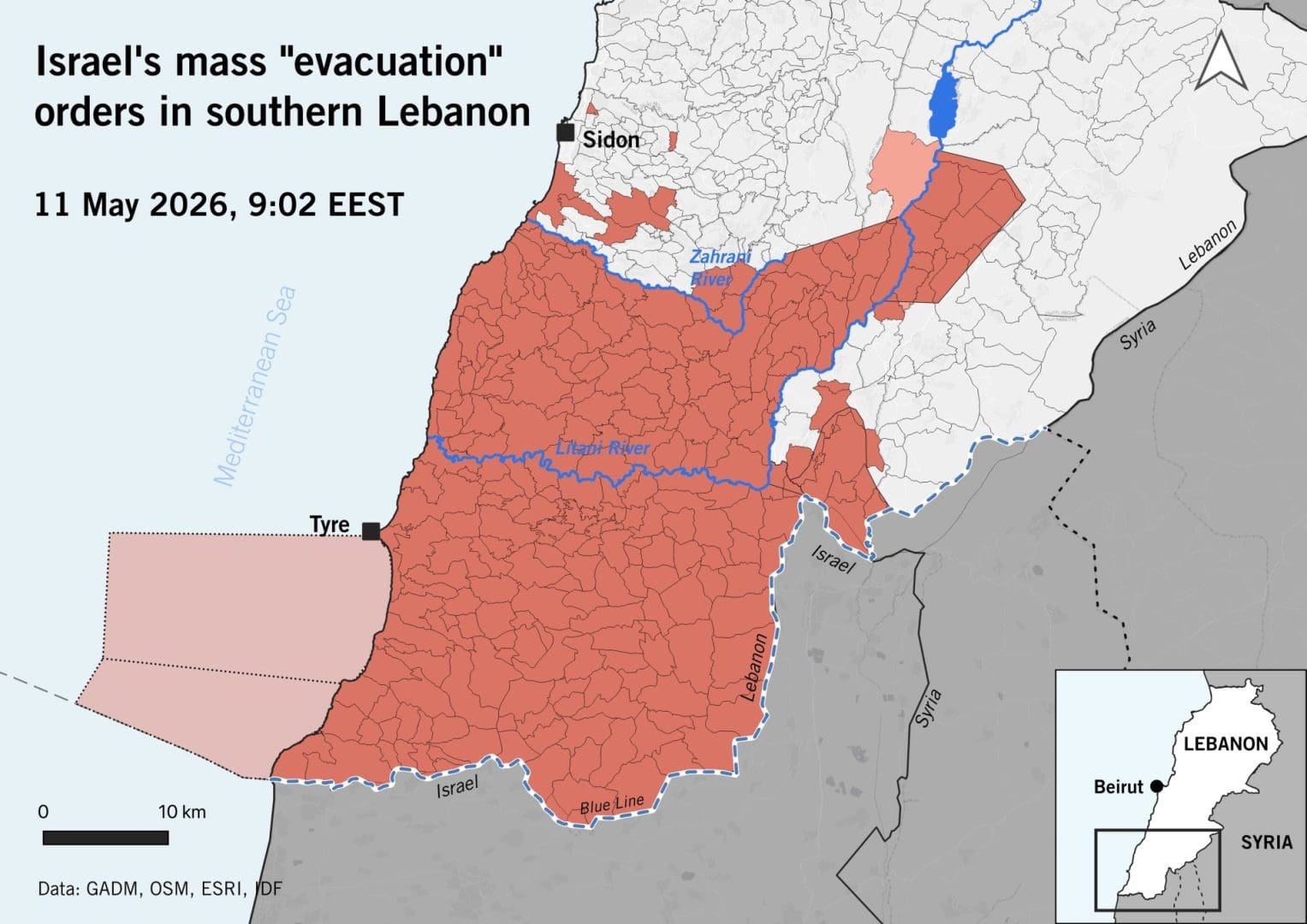
- Israeli military radically expanded its use of unlawful “everybody-leave” orders, displacing hundreds of thousands of people across Lebanon.
- Israeli military also expanded “don’t come back” orders, with residents in southern Lebanon indefinitely barred from returning to villages within Israel’s unilaterally declared buffer zone covering 6% of the country.
- In parts of southern Lebanon, the Israeli military’s forced displacement of civilians and prevention of their return amounts to unlawful transfer, which is a war crime.
The Israeli military’s repeated use of unlawful mass “evacuation” and no-return orders to displace and terrify hundreds of thousands of people in Lebanon flagrantly violates international humanitarian law, said Amnesty International. In southern Lebanon, these orders have been used as a deliberate tool to forcibly displace civilians from their homes, tens of thousands of whom Israel has then prevented from returning home. This constitutes unlawful transfer which, as a grave breach of the Fourth Geneva Convention, amounts to a war crime.
In a new investigation combining analysis of Israeli military orders issued to residents of Lebanon via X since 2024, interviews with people displaced from Israel’s unilaterally declared no-return zones, and open source analysis, Amnesty International found that the Israeli military radically expanded its use of mass displacement in Lebanon in 2026, subjecting far more residents, far more often, to a flood of unlawful mass “evacuation” orders, while it furthered its plan to destroy more homes and civilian infrastructure and depopulate large parts of the south.
“Over the past two and half years, hostilities between Israel and Hezbollah have taken a devastating toll on civilians. On top of this, Israel’s sweeping use of mass ‘evacuation’ orders covering large swathes of Lebanon have repeatedly and unlawfully displaced hundreds of thousands of people. In 2026, as in 2024, Israel’s indiscriminate orders came without measures to ensure the well-being and safety of evacuees, failed to provide meaningful information or guidance for civilians to make informed decisions about whether and for how long to flee, and were never revoked, even after hostilities in areas subject to these orders ceased, as required under international humanitarian law,” said Kristine Beckerle, Deputy Regional Director for the Middle East and North Africa at Amnesty International.
“In large parts of southern Lebanon, Israel’s ‘everybody-leave’ orders were followed by ‘don’t-come-back’ orders. Israel’s forced displacement and prevention of return of tens of thousands of civilians from southern Lebanon amounts to unlawful transfer, which is a grave breach of the Fourth Geneva Convention and thus a war crime. Instead of forcibly uprooting communities and designating entire swathes of Lebanese land as no-go zones for civilians, Israeli forces must immediately withdraw from Lebanese territory. Those displaced must be allowed to safely and freely return to their lands, and Israel must provide reparation for victims of its international humanitarian law violations, including those whose homes Israel unlawfully destroyed.”
Amnesty International’s analysis indicates the Israeli military significantly expanded the scale of its use of mass “evacuation” orders, issuing them more frequently and across larger areas of the country during the 2026 escalation compared to in 2024.
In response to Amnesty International’s questions, the Israeli military denied it was issuing mandatory evacuation orders, claiming it issued “advance warnings to civilians” and that these were not mandatory orders but “recommendations.” Amnesty International has previously explained why mass “evacuation” orders do not constitute effective advance warnings and distinguished between such warnings, issued ahead of an attack [pursuant to the principle of precaution] with respect to a specific location like a building, and mass “evacuation” orders, issued to lists of villages and large swathes of land, in its analysis.
The Israeli military claimed in its letter “there is no prohibition on Lebanese civilians returning to their homes,” but on June 15, after reports that the US and Iran had agreed on a ceasefire including Lebanon, Defense Minister Israel Katz said that Israeli forces “will remain in the security zones in Lebanon, Syria and Gaza without any time limit,” and that these zones would be “cleared of local residents and all terror infrastructure…including the houses in the contact-line villages that served as terror outposts…”
In addition to its mass “evacuation” orders, the Israeli military has also expanded the area of Lebanon subjected to its no-return orders. On November 28, 2024, the day after a previous ceasefire went into effect, the Israeli military designated an area covering roughly 4.6% of Lebanon a no-go zone.
In 2026, just three days after the April 17 ceasefire was announced, the Israeli military published a new map showing an expanded area covering 6% of Lebanon’s territory -designating it what they called a “Forward Defense” zone and told people not to return to a long list of villages inside the zone. The area was previously home to tens of thousands of civilians.
The Israeli military is deployed in the no-return zone and has, since 2024, carried out extensive destruction within it. Amnesty International previously documented how the Israeli military left a trail of deliberate destruction in parts of the no-return zone both before and after the 2024 ceasefire went into effect. By 2026, Sentinel 2, 10-metre resolution imagery showed almost full-scale clearing of almost all the municipalities along the border, which make up a large portion of the no-return zone, that Amnesty previously analyzed in 2024. Previously, isolated structures and sections of villages may have been left intact. Now, almost all of those have been leveled, and the heavy destruction has expanded to municipalities further within the no-return zone.
International humanitarian law strictly prohibits the forced displacement of civilians. Partial or total evacuations of civilians may be ordered only as an exceptional measure to ensure the security of the population or for imperative military reasons – arising directly from military operations – and must be used as a measure of last resort.
Any evacuation must be temporary, conducted in safe and humane conditions, and evacuees must be allowed to return to their homes as soon as hostilities in the area in question cease. Where civilians are forcibly displaced in absence of lawful grounds for evacuations, or are prevented from returning to their homes, this amounts to the grave breach of unlawful transfer under article 147 of the Fourth Geneva Convention, which is a war crime.
“Two and half years on it is critical for the international community to act, states must push for a durable and sustainable ceasefire, press the Israeli military to withdraw from Lebanese territory, activate national and international accountability and justice mechanisms, and suspend all transfers of arms and military equipment to Israel that would facilitate violations of international law,” said Kristine Beckerle.
Methodology
Amnesty International interviewed 19 people in March and April 2026, including 18 from areas subjected to mass “evacuation” and one aid worker. Of the 18, 12 remained displaced, including nine from villages subject to no-return orders and three from areas beyond the no-return zone. Six others had remained in Christian majority villages but reported the systematic collapse of basic services.
Amnesty International’s Evidence Lab analyzed 447 orders issued to residents of Lebanon and published on the Israeli military Arabic spokesperson’s X account between September 23, 2024 and May 31, 2026 and conducted a comparative analysis of orders issued during the 2024 and 2026 escalations, examining their scope, content, and frequency. Of these, 215 were advance warnings targeting specific locations, 36 were mass “evacuation” orders during the 2024 escalation, 135 were mass “evacuation” orders during the 2026 escalation, and 61 were no-return orders ordering residents not to return to evacuated areas.
Amnesty International wrote to the Israeli military on May 22, 2026 about its findings and received a response on June 3, 2026.
Everybody-leave orders: Israel’s escalating use of mass “evacuation” orders
Since 2024, the Israeli military has issued sweeping and indiscriminate mass “evacuation” orders that have instructed residents to leave their homes immediately and indefinitely and have come without measures to ensure the well-being and safety of evacuees, as required under international law. While allegedly used to inform civilians of upcoming hostilities that might endanger them, the orders, sometimes issued in the middle of the night or accompanied by ambiguous maps, have covered entire villages, list of villages, and huge swathes of land.
Amnesty International found these mass “evacuation” orders failed to provide meaningful information about where or when the Israeli military might strike or guidance for civilians to make informed decisions about whether and for how long to flee. While some orders covered areas that, at the time, had active fighting or where the Israeli military subsequently carried out attacks, orders also included areas that were far from fighting.
Since 2024, the Israeli military has significantly increased its use of mass “evacuation” orders compared to its use of more specific advance warnings. This shift was especially evident in Dahieh, Beirut’s southern suburbs: In 2024, the Israeli military issued no mass “evacuation” orders for Dahieh. In 2026, it issued 27 such orders between March and May. The number of advance warnings the Israeli military issued for specific buildings in Dahieh plummeted from 107 in 2024 to 15 in 2026 – only three of which were published after the first mass “evacuation” order to the area.
Residents of southern Lebanon have been particularly impacted by Israel’s use of unlawful mass “evacuation” orders, and particularly in 2026. Between September 2024 and May 2026, the Israeli military published 171 mass “evacuation” orders to residents of Lebanon on its X account – 135 of these in 2026. About three quarters (76%) were issued to southern Lebanon. The rest were split among Beirut’s southern suburbs (15%) and the Beqaa valley (5%).
Within the first 48 hours of the 2026 escalation, the Israeli military issued its largest mass “evacuation” order to date, covering all areas south of the Litani River – around 8.5% of Lebanon. A few days later, the Israeli military issued an even broader order, covering the area south of the Zahrani River, roughly 10% of Lebanon and home to some 800,000 people. The Israeli military republished the same order 13 times until April 17, 2026, when a ceasefire was declared. Hostilities continued, at a lower intensity at first, before escalating again.
On May 27, 2026, the first day of Eid al-Adha, the Israeli military issued the incredibly broad order again, instructing all residents of southern Lebanon to evacuate north of the Zahrani river, stating that the Israeli military considers “all the areas south of the river… combat zones.” New orders also included villages above the Zahrani river, amounting to 15% of the whole country.
“Issuing sweeping ‘evacuation’ orders does not absolve the Israeli military of its obligations under international humanitarian law, including to take all feasible precautions to minimize harm to civilians, and certainly does not give the Israeli military the right to treat these areas as open-fire zones,” said Kristine Beckerle.
In many parts of Lebanon, Israel’s “leave-now” orders were repeated again and again.
“Hala” (pseudonym), in her early sixties, from Chaqra, a village in the Nabatieh Governorate in southern Lebanon, faced repeated mass “evacuation” orders – two in October and November 2024 and at least five more between March and May 2026, including one shortly after the April 17 ceasefire was announced.
On March 2, 2026, at 4:04am, the Israeli military issued a mass “evacuation” order for Chaqra and 52 other villages. Hala did not see the order. By the morning, many people had fled the village. “Everyone left before me…the entire neighborhood was empty,” she said. When she finally found transport, the journey to Beirut, usually about two and a half hours, took 24 hours.
Following the April 2026 ceasefire, parts of Chaqra, along with 20 other villages, fell on a line unilaterally set by the Israeli military to demarcate the inner boundary of the “no-return zone.” Displaced residents were allowed to return to parts of their village but were barred from areas south of the line.
Hala briefly visited her house on April 20, to collect some summer clothes, before returning to Beirut. Eight days later, the Israeli military issued another mass “evacuation” order that included the whole of Chaqra.
“There isn’t much life in my village. Most people who returned [after the ceasefire] have already left again,” Hala said.
‘Don’t come back’ orders: Israel’s expanded no-return zone
Israeli officials have publicly stated the aim of establishing a “buffer” or “security” zone inside Lebanese territory to protect residents in northern Israel from potential Hezbollah attacks. They have explicitly linked the large‑scale and prolonged displacement of residents, as well as further destruction in southern Lebanon, to this objective.
On April 20, 2026, three days after the April 17 ceasefire was announced, the Israeli military published a map designating a “Forward Defense” zone extending 8 to 12 km into Lebanese territory and covering about 600 km² of land and sea. The Israeli military listed 74 villages, barring residents from returning to 53 villages and from crossing south of 21. The Israeli military also prohibited approaching the Litani river and al-Salhani and al-Saluki valleys.
The April 2026 map expanded the map of the no-return zone published by the Israeli military on November 28, 2024, the day after a previous ceasefire went into effect. The 2024 map covered roughly 480 km², or 4.6% of Lebanon and listed 68 villages, including 58 where residents were barred from returning and 10 where crossing south was prohibited.
The Israeli military’s maps and lists of villages contained geographical inaccuracies, repetitions, and misspellings, creating confusion over which areas residents were ordered not to return and which areas residents could safely return.
In March and April 2026, Amnesty International interviewed nine people displaced from villages included in the 2024 and 2026 no-return orders issued by the Israeli military. Five were able to return to their homes in 2025 but were displaced again in 2026. Four were prevented from meaningfully returning home since 2024.
Between November 2024, when the Israeli military issued its first no-return zone map, and February 2025, when the Israeli military withdrew from parts of southern Lebanon, the Israeli military issued 35 notices prohibiting residents of southern Lebanon from returning to their homes until further notice. Six of these messages specifically barred access to olive groves. Agriculture is a major source of income for the region, which comprises more than a third of Lebanon’s total olive harvest. Over this period, the Israeli military killed at least 81 civilians and injured 120 while they were attempting to reach southern villages, according to OHCHR.
On February 18, 2025, the Israeli military withdrew from parts of southern Lebanon but remained in a handful of “strategic” points. Beyond these points, the Israeli military had extensively destroyed civilian property and continued to operate drones and carry out sporadic attacks.
Five of the displaced residents who spoke with Amnesty International said they were able to return to their villages in 2025 after the withdrawal. All five described how they began to rebuild their homes, despite the extensive destruction and near constant drone surveillance. All five were once again displaced in March 2026 and had been unable to return by May.
Four of the displaced residents who spoke with Amnesty International said they had not been able to meaningfully return home since 2024. The four were from Kfar Kila and Odeisseh, both villages located between 100 and 300 meters from the Israeli border. They cited extensive destruction to their homes and villages, ongoing Israeli military presence, and the risk of being attacked as the primary barriers to their return. Amnesty International examined the Israeli military’s extensive destruction to Kfar Kila and Odeisseh in a 2025 report.
All four, who remain displaced, said they had to request permission to return to their villages for even extremely short visits to bury their loved ones.
“Salma” (pseudonym), who returned to Kfar Kila to bury her grandmother, said: “They gave us 10 minutes…The [Israeli] drone was above you… You gather yourself and go, you cry for 10 minutes and leave, all on the road they specified for you.” On March 30, 2026, she saw news reports indicating the old cemetery where much of the family was buried had been bulldozed.
Joumana, whose home in Odeisseh was demolished by Israeli forces in 2024, returned to the village to bury her aunt who had died of cancer while displaced. They received permission to do the burial in April 2025, under the supervision of the Lebanese military, while Israeli drones hovered above them: “To exhume [the remains], carry the coffin again, hear the prayers again, reopen the grave, and rebury—this is the harshest thing I have lived through.”
She described the destruction in their village: “There were no roads. I drove a short distance and suddenly found myself in open fields; the road had been bulldozed and merged into farmland… Houses are destroyed, buildings have disappeared, roads are torn up, no water, no electricity… No one has returned to the village. There is no life there.”
Background
This research is the first in a series of investigations examining violations of international law during the 2026 escalation in Lebanon.
As of June 7, 2026, the Lebanese Ministry of Social Affairs reported more than one million people remained displaced. An estimated 64,000 people had remained displaced after the 2024 ceasefire.
Since the war escalated on March 2, by June 12, more than 3,700 people had been killed in Lebanon, according to the Ministry of Public Health. Despite multiple ceasefire announcements, hostilities have continued, with Israel and Hezbollah continuing to trade attacks, Israel conducting air strikes across Lebanon, and Hezbollah firing rockets and drones into Israel.
Contact: [email protected]