
Responding to the Hong Kong government gazetting legislation that makes clear the city’s Chief Executive can designate certain criminal cases as national security cases, Joey Siu, the spokesperson of Amnesty International Hong Kong Overseas, said:
“It is deeply alarming that the Hong Kong authorities continue to reinforce the powers of the city’s national security laws, which have contributed to grave human rights violations and should have long since been repealed.
“This legislation, which allows the Chief Executive to designate any criminal act as ‘involving national security,’ shows the Hong Kong government’s intent to deploy its sweeping powers in a way that severely undermines defendant rights at every stage of legal proceedings — from investigation and bail applications to trial proceedings and release.
“Amnesty’s research has previously highlighted concerns about defendants’ rights to a fair trial in national security cases, including through the replacement of jury trials with judges appointed by the Chief Executive, the systematic denial of the presumption of bail, and the punitive denial of early release.
“This legislation provides a further pretext for the government to exploit ‘national security’ to systematically repress dissent and create a widespread chilling effect on anyone who dares to be critical of the authorities.”
Background
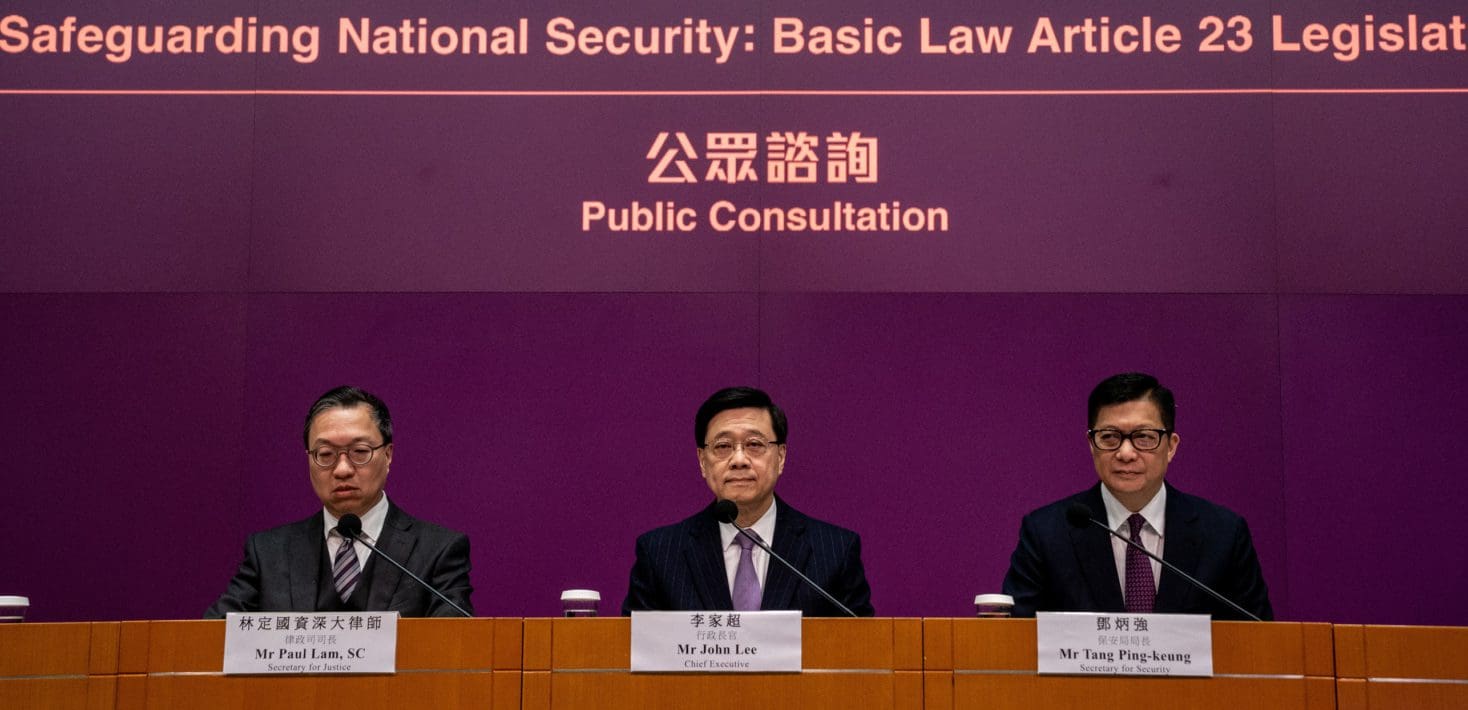
On June 8, the Hong Kong government proposed subsidiary legislation under Section 110 of the Safeguarding National Security Ordinance (SNSO) – also known as Article 23 – that crystalizes the Chief Executive’s power to designate certain acts in a criminal case as “involving national security.”
This could in theory turn any criminal case into a national security case, meaning it would be bound by the specific legal procedures under the national security regime, including the presumption against bail and being tried only by judges selected by the Chief Executive.
Just one day after proposing it, the Hong Kong government today gazetted the legislation with immediate effect and without public consultation.
Since the imposition of the National Security Law on June 30, 2020, the human rights situation in Hong Kong has deteriorated drastically. Civil society has been effectively dismantled, while long-standing rights — including the rights to freedom of expression, peaceful assembly and association — have been severely curtailed.
On March 19, 2024, Hong Kong’s Legislative Council unanimously voted to pass the SNSO based on Article 23 of the Basic Law, Hong Kong’s mini-constitution. The law, which took effect on March 23, 2024, introduced China’s definition of “national security” and “state secrets,” together with other broadly defined offenses which further restrict freedom of expression and the right to protest. It also replaced a widely used colonial-era sedition law with its own provisions on sedition which now expressly cover acts or speech which do not incite violence.
Contact: [email protected]