
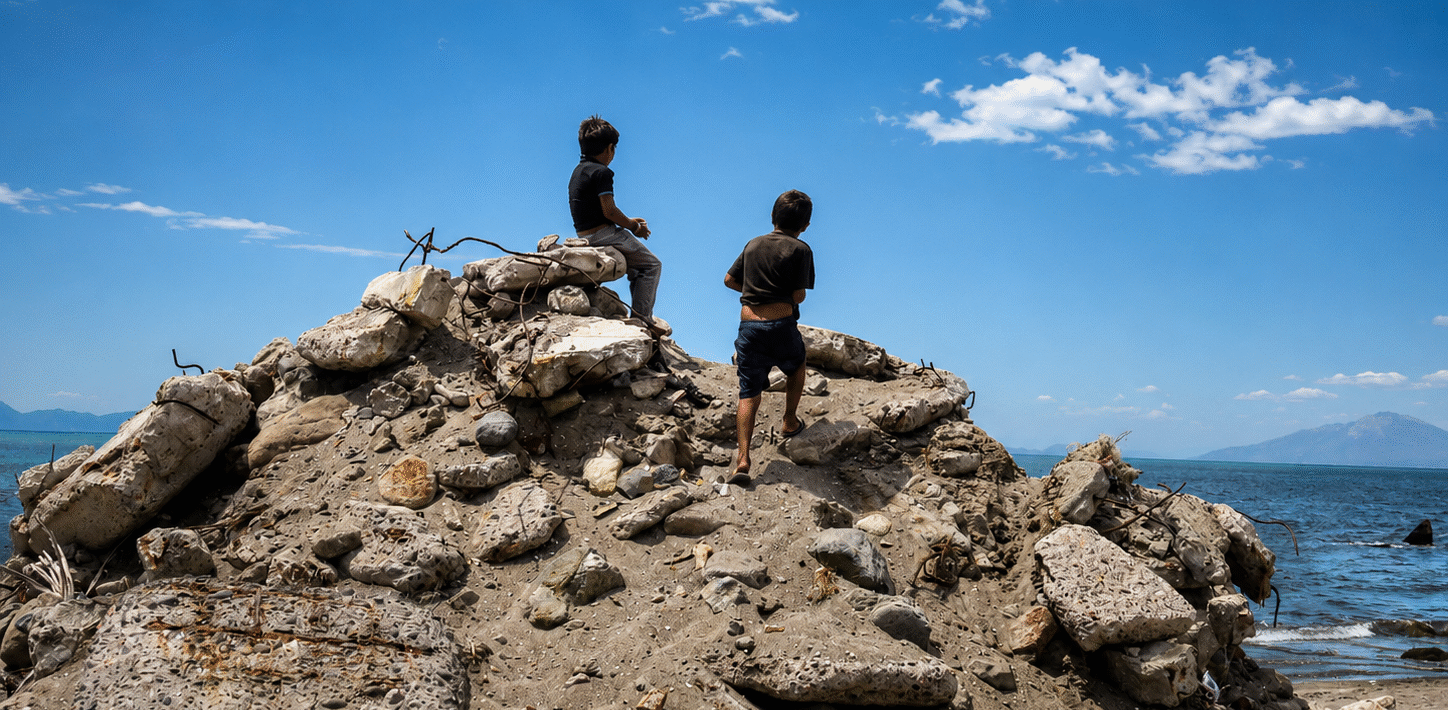
The coastal community of Cedeño, in the Gulf of Fonseca, is facing a human rights crisis caused by the impacts of climate change, including coastal erosion, rising sea levels and the lack of an adequate state response, Amnesty International said today as it launched its new report, Cedeño: “Losing everything, home and children”. Climate displacement from the Honduran Pacific coast.
The report reveals that in this area, which was impacted just days ago by Tropical Storm Cristina, the coastline has retreated by around 135 meters between 2004 and 2026, equivalent to 6.13 meters per year. This loss of territory is directly affecting the enjoyment of human rights by people living in Cedeño.
“The heartbreaking situation facing the people of Cedeño today is the result of years of climate inaction, both by the Honduran state and the international community. Today, their rights to water, food and housing are under threat, which also compromises their right to a dignified life. The testimonies gathered are a cry for help that demands immediate attention,” said Ana Piquer, Americas Director at Amnesty International.
Rights at risk
Although its greenhouse gas emissions are minimal, Honduras is among the countries most affected by climate change worldwide. In Cedeño, repeated storm surges, coastal erosion and rising sea levels are putting the rights of its inhabitants at risk.
Access to water is limited. Very few people have access to the water distribution network because of damage caused by successive storm surges. As a result, most of the families interviewed obtain water from wells they have dug themselves, but the water is not suitable for consumption due to contamination and salinization of freshwater sources.
The food security of hundreds of people is also at risk. The main livelihood of families in this area is artisanal fishing, but this activity is increasingly threatened. Not only are incomes reduced when storm surges prevent boats and small vessels from going out; fishers have also observed a decline in their catches, linked to ecosystem degradation, including mangrove deforestation, while there are no other sustainable alternatives to generate income.
In central Cedeño, storm surges have also damaged community infrastructure, beach restaurants, businesses and homes. Although there is no exact figure for the number of houses destroyed, several testimonies describe people who have lost and rebuilt their homes more than once.
“I have two daughters in the United States, without papers, and they send me money to survive. We lived happily before I lost my house and my business to the storm surge. If that had not happened, they would not have left,” said Sonia*, a resident of Cedeño.
The findings of the investigation show that, in the face of this situation, the response of the Honduran authorities has been very limited. Families often pay out of their own pockets — already strained by the cost of buying drinking water and growing dependence on external food sources — to rebuild or repair their homes and businesses, which, according to their testimonies, also leads to debt.
Amnesty International concludes that, taken together, the impacts of climate change and the failure of the Honduran authorities to provide assistance and respond adequately to the needs of affected people violate their right to a dignified life.
Dignified and comprehensive relocation
Beyond the humanitarian assistance occasionally provided by the Permanent Contingency Commission (COPECO) and other institutions in the event of sudden disasters, there is no mechanism in national legislation to address the needs of people who require more permanent relocation due to the impacts of climate change or other disasters. Honduras’ law on displacement and the National Response System for Internally Forced Displacement (SINARDEFI) only address people displaced by violence.
Since May 2025, people organized through Cedeño’s climate justice roundtable have approached the mayor of Marcovia, the municipality to which Cedeño belongs, as well as several government ministries, requesting the establishment of an inter-institutional roundtable to address their needs and, above all, organize the planned, dignified and comprehensive relocation of their homes. According to their estimates, around 990 people currently need to be relocated due to the risks facing their homes.
Amnesty International welcomes the announcement made on June 3, 2026 by the Honduran government to create an inter-institutional technical roundtable, coordinated by COPECO, to address the situation of communities affected by the advance of the sea in Cedeño.
The organization calls on the government to ensure that this announcement translates into a relocation plan that complies with international human rights standards, has sufficient resources for its implementation, and guarantees the effective participation of the community throughout the process.
In addition, given projections of an increase in the number or intensity of weather events due to global warming, Amnesty International urges Congress to create a legal framework to address people displaced by the impacts of climate change and disasters, and to regulate planned relocation processes in line with the international obligations established by the Inter-American Court of Human Rights in its Advisory Opinion 32/25.
Climate displacement
The testimonies received show that the impacts of storm surges and the lack of human rights guarantees in Cedeño are a catalyst for both internal and cross-border climate displacement, particularly among young adults.
The report highlights the insufficiency of safe and regular migration pathways from Honduras, especially for those pushed to migrate by the climate crisis. This situation has forced people from Cedeño into irregular migration. Many are in the United States without regular migration status and fear being deported.
States, including the United States and Mexico, have an obligation not to return people to their countries of origin if they fear suffering human rights violations in the context of the climate emergency and disasters. However, in practice, they have implemented measures that restrict access to international protection and routinely violate human rights.
The hardening of migration policies in Mexico and the United States puts the lives of thousands of people at risk. Amnesty International calls on these states to refrain from returning to Honduras people with international protection needs, and calls on the international community to establish new rights-based migration categories and expand existing ones to protect those most affected by the impacts of climate change and disasters.
“Cedeño shows a double injustice: people are being forced from their territory by a climate crisis they did not cause, while at the same time facing increasingly restrictive migration policies when they seek protection or alternatives for their lives. The response cannot be abandonment or deportation. It must be protection, climate justice and international cooperation,” said Ana Piquer.
Lack of climate adaptation and financing
The documentation analyzed shows that successive Honduran governments have been aware of the situation in Cedeño for more than 20 years. More recently, Honduran authorities have recognized the human rights impacts faced by coastal populations and the need to adopt measures to protect them from the impacts of climate change, as well as to protect ecosystems. However, the living conditions of the people of Cedeño have continued to deteriorate.
Amnesty International considers that the abandonment experienced by these communities is closely linked to the lack of climate adaptation measures by the Honduran government. Although Honduras has a legal and institutional framework on climate matters, it faces serious challenges in implementing its climate strategies due to limited resources and institutional capacity.
According to the Inter-American Court of Human Rights, the State of Honduras has an obligation to adopt measures to protect the human rights of its population in the context of the climate emergency, including the rights to water, food and housing. These measures are also essential to prevent forced migration and displacement resulting from disasters and the impacts of climate change.
“The investigation shows that, despite the major challenges it faces, the Honduran government has a number of opportunities to advance the implementation of the climate strategies urgently needed by the people of Cedeño and the population more broadly, and to adapt its legal framework to guarantee the rights of people displaced by disasters and climate change. This government must not miss these opportunities,” added Ana Piquer.
These challenges take place in a context of insufficient international climate finance, as highlighted by the previous Honduran government. While all countries have an obligation to collectively combat climate change, Amnesty International underlines that major emitters have a responsibility to support low-income countries with climate finance. In this regard, Amnesty International has called for such support to preferably take the form of grants rather than loans, so that countries like Honduras can finance climate adaptation and mitigation measures, as well as reparations for loss and damage, without going further into debt.
Contact: [email protected]