
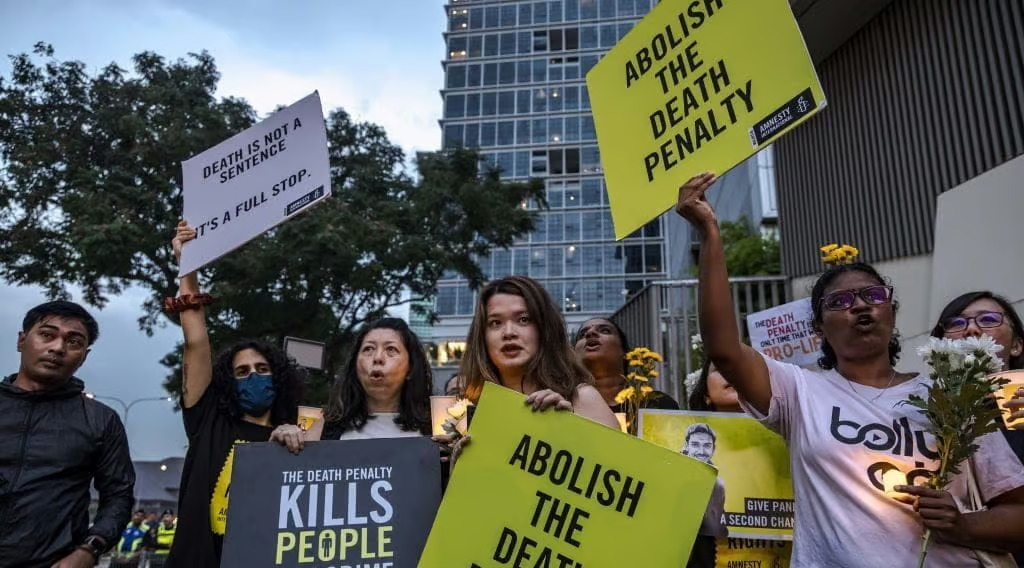
The UN Office on Drugs and Crime (UNODC) and the Commission on Narcotic Drugs (CND) must take urgent action to condemn the unlawful use of the death penalty for drug-related offenses and work with UN member states towards abolishing this cruel punishment once and for all, Amnesty International and Harm Reduction International said ahead of World Drug Day on June 26.
Drug-related executions have soared in recent years, representing more than 40% of the total number of executions recorded worldwide. In 2025 alone, close to half (1,257 or 46%) of all known executions recorded independently by Amnesty International and Harm Reduction International were for drug-related offenses, in five countries: China, Iran, Kuwait, Saudi Arabia and Singapore. Meanwhile, Algeria, Kuwait, and the Maldives made legislative efforts to expand the scope of the death penalty to include drug-related offenses.
Jordan also resumed executions earlier this week, for the first time in nine years, executing six people, while the Prime Minister announced plans to expand the scope of the death penalty to include certain drug-related offences.
“The death penalty is an abhorrent practice with no place in today’s world. As executions for drug-related offenses reach shocking levels, the continued silence and inaction from UNODC and the CND is deplorable and leave their stated commitment to human rights empty of meaning,” said Chiara Sangiorgio, Amnesty International’s expert on the death penalty.
“Any use of the death penalty is a violation of human rights. But its use for drug-related offenses is prohibited under international law and standards. It is high time that the UN bodies overseeing international drug policy confronted the harms caused by punitive practices and make the abolition of the death penalty a priority worldwide,” said Catherine Cook, Executive Director of Harm Reduction International.
Every year, the launch of the World Drug Report on June 26 provides a public platform for the UN Office on Drugs and Crime to condemn the use of the death penalty specifically as a tool of drug control, and to recommend specific measures that retentionist countries can adopt to bring domestic drug policies in line with international law and standards, as a first step. To date, it’s been falling short.
In a public statement, Amnesty International, Harm Reduction International and 61 other organizations, are calling for several concrete and immediate actions from UNODC, including for the World Drug Report to include a specific chapter on human rights, updated information on the use of the death penalty for drug-related offenses, and an explicit commitment to promote the abolition of the death penalty in the new UNODC strategy.
“The death penalty for drug related offences is unlawful, arbitrary and discriminatory, and it must be tackled head on. As the main UN body overseeing drug control, UNODC can and should play a critical role in turning the tide of executions,” said Chiara Sangiorgio. “Our message today is clear – the world is watching, and we will not stop demanding action until the world is free from the shadows of the gallows”.
Contact: [email protected]