
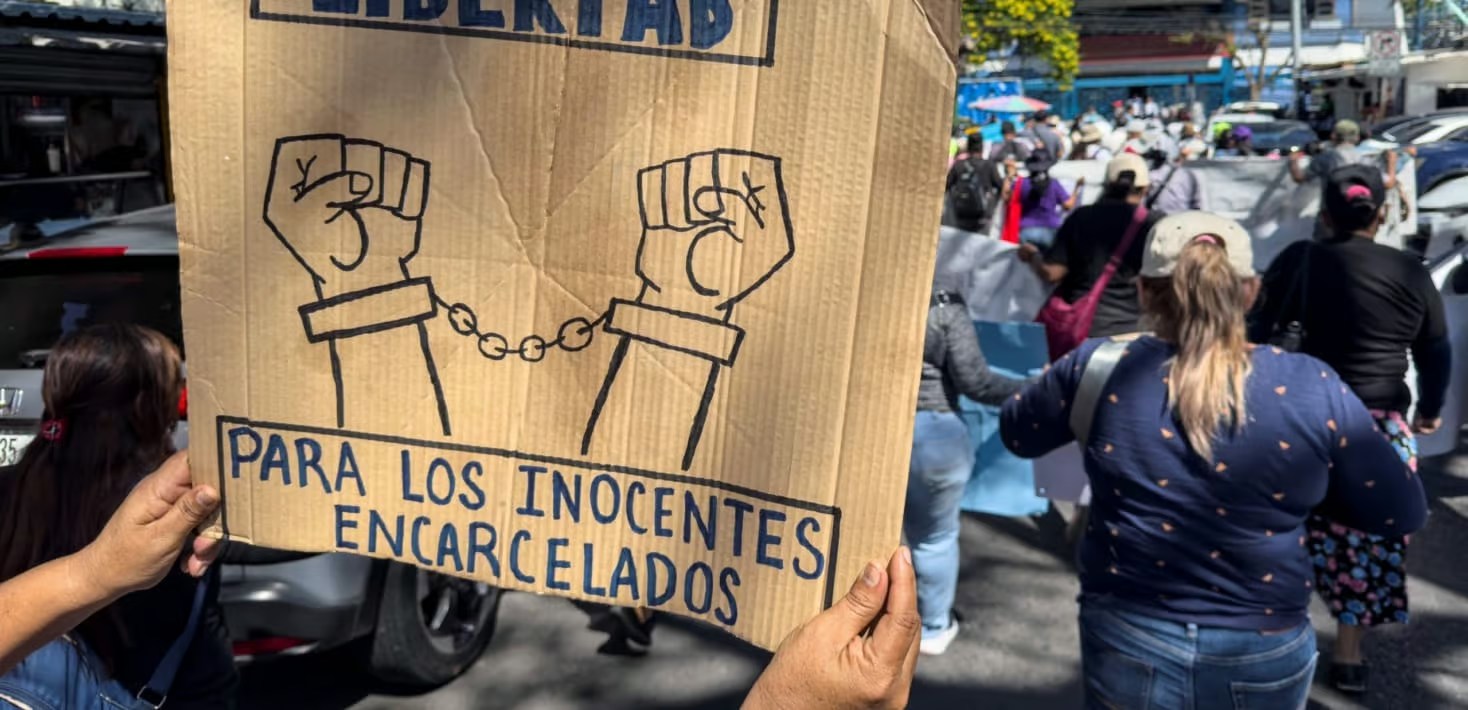
What began as a temporary measure allegedly to combat gang violence has evolved into a permanent system that promotes and justifies mass arbitrary detentions, the suspension of guarantees, and serious human rights violations that could amount to crimes against humanity. These are the conclusions reached by Amnesty International in its new report “Security” without rights: The impact of mass arbitrary detentions and denial of due process on the possible commission of crimes against humanity in El Salvador.
Four years after the introduction of the state of exception, more than 90,000 people have been detained, at least 470 have died in state custody and thousands of families continue to seek answers about the whereabouts, health or legal status of their loved ones. The report documents how exceptionality was progressively transformed into a permanent security policy based on the prolonged suspension of rights and the systematic weakening of the rule of law.
“Security cannot be built on arbitrariness, torture, enforced disappearances and the annulment of due process,” said Ana Piquer, Americas director at Amnesty International. “The state has an obligation to protect the population from criminal violence and to investigate and punish crimes committed by gangs, but that obligation does not authorize the commission of serious human rights violations.”
The research is based on six fact-finding visits conducted between May 2022 and January 2025, 109 interviews with victims, their relatives, lawyers, public defenders, private defense attorneys, and active and retired members of the National Civil Police (PNC), as well as an analysis of charging documents, court rulings, legislative decrees and a direct review of more than 80 individual cases.
The report reveals how active and retired PNC officers described a system of detention quotas, verbal instructions without documentary support and institutional pressure to fabricate records that would lend an appearance of legality to arbitrary arrests. It also records the use of outdated databases and profiling based on territorial and socio-economic criteria by the Salvadoran authorities to justify mass arbitrary detentions.
“In many cases, no one verifies whether the detentions are lawful or not. We just bring people in, the Attorney General’s Office receives the package, and that’s it. No judge sees anything at that moment […]. By the time they are taken to court, fifteen days have gone by, and the judges simply read the list and confirm everything. No one asks whether there were beatings or whether there was an arrest warrant,” said a PNC officer interviewed by Amnesty International.
This situation is exacerbated by another of the report’s central findings: the adoption of procedural reforms incompatible with international human rights standards that have progressively transformed the Salvadoran criminal and judicial system. In numerous documented cases, the courts have ceased to exercise effective control over the actions of police, prosecutors and other state authorities, and have instead become bodies that validate arbitrary detentions and uphold serious deprivations of liberty even in the absence of verifiable evidence or sufficient individualized assessments.
“In many cases, it no longer matters whether evidence exists or not. It is enough for the police to say that someone ‘looks like a gang member’ for the system to prosecute them,” said a defense attorney interviewed by Amnesty International. “We are seeing cases in which behaviors are not individualized, specific facts are not described, and detention becomes practically automatic.”
Amnesty International concludes that the documented patterns — mass arbitrary detentions, torture, enforced disappearances and deaths in state custody — could constitute crimes against humanity under Article 7 of the Rome Statute, as there are reasonable grounds to believe that these acts may have been committed as part of a widespread and systematic attack against the civilian population, in an institutional context that has facilitated their commission.
Amnesty International has again identified a strong discriminatory component in the implementation of the state of exception. Most of the documented victims come from historically impoverished and stigmatized communities, many of which had previously been affected by gang violence. The research shows that factors such as place of residence, physical appearance, socioeconomic status or unverified anonymous accusations have frequently been used to justify arrests and sustain criminal charges.
The report also documents how, during judicial hearings, arguments relating to ties to the community presented by the defense — such as formal employment, family ties, studies, fixed residence or community participation — are frequently dismissed without sufficient individualized assessment. According to Amnesty International, this has contributed to turning pre-trial detention into a virtually automatic, rather than exceptional, measure.
Although the Salvadoran government presents the state of exception as a successful security policy, Amnesty International has warned that the human cost has been borne mainly by people without a final conviction, detained without a warrant, without individualized investigation and, in many cases, without verifiable evidence against them.
“This investigation shows that the Salvadoran authorities have allowed their security policy to lead to systematic and widespread human rights violations that could amount to crimes against humanity, also affecting thousands of people against whom there is no robust indication that they have committed crimes,” said Ana Piquer. “The findings of this report are not intended to prevent authorities from investigating people suspected of committing crimes or criminal structures, but to ensure that they do so within the framework of due process.”
“Amnesty International demands that those who have not committed crimes — and the evidence shows that they could number in the thousands — do not continue to pay with their freedom, their health or even their lives for a policy designed to produce numbers, not justice. This is not equivalent to calling for the indiscriminate release of people, but rather to ensuring that those who remain deprived of liberty are subject to credible investigations and fair trials for their possible involvement in crimes.”
The report records deaths in state custody, patterns of torture and other ill-treatment, including beatings, prolonged incommunicado detention, systematic denial of medical care and detention conditions incompatible with human dignity.
Amnesty International has also documented patterns of enforced disappearance, both in the initial stages of detention and during deprivation of liberty. In numerous cases, the authorities concealed the whereabouts of detainees for days or weeks, refusing to provide family members with information on their location or physical condition. In others, individuals remained deprived of liberty despite final court rulings ordering their release that were not executed by prison authorities. Family members interviewed described desperate searches in prisons, morgues and courts without obtaining official information on the whereabouts of their loved ones, temporarily placing them outside the protection of the law.
The report concludes that these abuses are not isolated events, but have been facilitated by a profound institutional transformation that began in 2021, including the dismissal of magistrates from the Constitutional Chamber and the Attorney General, legal reforms that undermined due process, and the growing militarization of public security.
“El Salvador had and continues to have a duty to protect the population from criminal violence. But no state can effectively combat violence by reproducing the same patterns of fear, discrimination, abuse and impunity it claims to fight,” concluded Ana Piquer. “The experience in El Salvador demonstrates the enormous risk of normalizing security models that promise immediate results through a purely repressive approach, without considering due process safeguards or respect for human rights.”
Amnesty International urges the Salvadoran state to adopt a verifiable plan to end the state of exception, fully restore due process guarantees, independently investigate documented violations and, where sufficient evidence exists, prosecute those allegedly responsible for crimes under international law, including crimes against humanity. It also urges the state to guarantee unrestricted access for international human rights mechanisms to detention centers and judicial proceedings related to the state of exception. Finally, it calls on the international community to strengthen independent monitoring and international accountability mechanisms in relation to the human rights situation in El Salvador.
Contact: [email protected]