
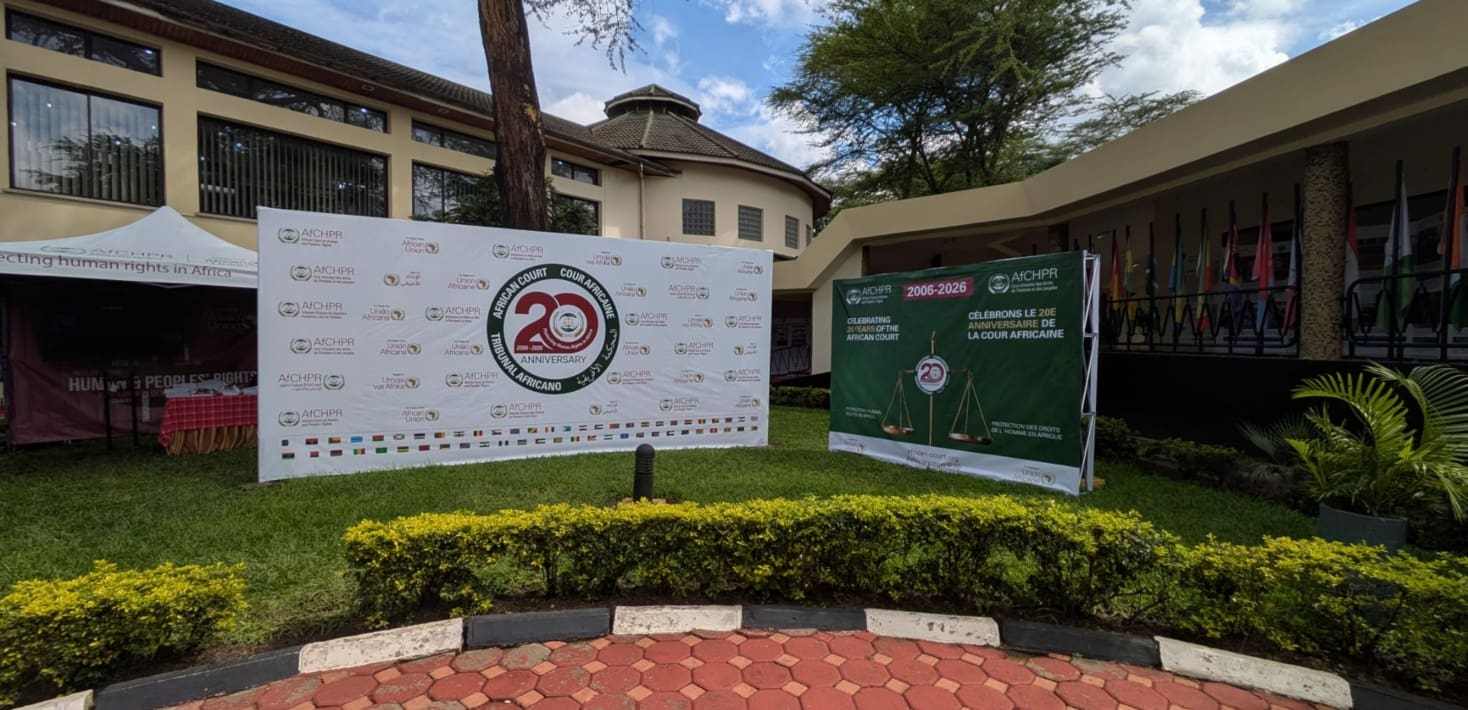
African Union (AU) member states must ensure full political, legal and financial support for the African Court on Human and Peoples’ Rights (African Court), to enable it to effectively carry out its mandate to protect human rights, Amnesty International said today as it launched a new report marking the Court’s 20th anniversary.
Released on International Justice Day, the report, ‘20 Years of the African Court – Protect the Court, Protect the People’, examines the successes achieved and the challenges faced in two decades by the Court, which serves as an important regional judicial avenue for individuals and civil society organizations.
Yet despite the African Court’s crucial role in delivering justice, only 34 of the AU’s 55 member states have ratified the protocol establishing the regional human rights court. And as of July 2026, only seven allow individuals and NGOs to directly submit complaints to the Court.
“The African Court is an essential judicial avenue for individuals and civil society organizations who cannot obtain prompt, effective and adequate remedy for human rights violations in their own countries. Despite its challenges, the African Court has demonstrated dynamism and agility in examining the cases brought to it, developing strong jurisprudence and expanding the protection of human rights in Africa,” said Japhet Biegon, Deputy Regional Director for East and Southern Africa at Amnesty International.
“It is vital that every AU member state ratifies the African Court Protocol and makes the declaration that would allow individuals and NGOs to directly access the Court, so that the African Court is able to continue to protect human rights in a meaningful way for decades to come.”
Why the African Court matters
Since becoming operational in 2006, the African Court has finalized over 250 cases, including almost 150 in which it determined whether one or several human rights violations had been committed. Many of the Court’s final judgments relate to the rights to a fair trial, to dignity and to be free from torture and other ill-treatment for detainees, and to election-related matters.
In addition, the African Court has issued several landmark decisions, including concerning the protection of the most vulnerable. Among them, the Zongo and Konaté judgments against Burkina Faso in 2014 strengthened media freedom in the law and the fight against impunity for attacks against journalists in the country. The Ogiek case against Kenya in 2017 affirmed the recognition of the rights of an indigenous community while the 2023 judgment against Côte d’Ivoire concerning the dumping of chemical waste by privately-owned Probo Koala cargo ship developed crucial jurisprudence for the protection of the environment and peoples’ right to health. Most recently in 2025, the Court issued an important decision related to combating discrimination and attacks against persons with albinism in Tanzania.
Due to the restrictions in accessing the Court, the number of cases against states from Central Africa, North Africa and South Africa is very limited, leading to a high geographical disparity and an underrepresentation of these three regions of the continent in the Court’s jurisprudence.
More support needed from AU member states
Twenty-one AU member states have yet to ratify the Protocol establishing the African Court. Only a dozen have ever made the requisite declaration allowing individuals and NGOs to petition the Court directly. Of these, five states (Benin, Côte d’Ivoire, Rwanda, Tanzania, and Tunisia) withdrew the declaration, depriving their people of an avenue for justice.
Other actors entitled to bring cases directly to the African Court such as AU member states, African intergovernmental organizations and the African Commission on Human and Peoples’ Rights have rarely done so. The Commission, another AU body charged with promoting and protecting human rights, has only referred three cases to the African Court over the last 20 years.
“Limited access remains one of the African Court’s biggest obstacles. We join with civil society organizations, bar associations, academic institutions, and people across the continent in calling for AU member states to enable the African Court to fully live up to its promise. Enabling and protecting the Court would contribute to protecting the rights of the African people,” said Japhet Biegon.
“The African Commission must be encouraged to make more use of its mandate to transfer cases to the African Court, to foster better complementarity between the two human rights bodies and to mitigate the current restrictions in access to the Court.”
Low implementation of African Court decisions
The report also documents delays by states parties to the African Court Protocol and African Union member states in putting in place measures ordered by the Court to remedy human rights violations. The AU political bodies, particularly the Executive Council, have not been proactive enough in ensuring that the Court’s judgments, binding in nature, are promptly followed by state actions.
“We call on all states concerned to implement fully and effectively all judgments of the African Court issued against them, and on the AU to diligently monitor and practically ensure states’ compliance with the Court’s decisions,” said Japhet Biegon.
Background
The African Court seats in Arusha, Tanzania, and is composed of 11 judges elected by the AU Assembly. Its mission is to protect, promote and defend human rights enshrined in the African Charter on Human and Peoples’ Rights and other applicable human rights instruments by determining cases of alleged human rights violations or by issuing advisory opinions on the interpretation of the African Charter and other relevant human rights treaties. It started its operations on July 2, 2006, when the first batch of judges were appointed.