
Thank you for choosing to take part in Amnesty International’s Freedom Pages Art and Literature Competition! Each year during Banned Books Week, Amnesty International spotlights the stories of individuals around the world who have been threatened, imprisoned, or disappeared because of their writing, spoken word, art, or other creative published work.
Our 2026 cases feature a poet from Algeria, a social media influencer from Mali, a women’s human rights defender and writer from Iran, a journalist from the United States, a journalist from the Philippines, an indigenous leader and climate activist from Russia who has written extensively on culture and climate, and two Palestinian photojournalists who were detained by Israeli forces and continue to be held in conditions that constitute enforced disappearance.
CONTEST DETAILS
Choose one of the prompts below and bring it to life through your own unique artistic or literary creation.
- Reflect on censorship and governments silencing dissent in your community and abroad. Think about the lost jobs, revoked visas, constant surveillance, or disappearance from public life that people face when they challenge harmful power structures. Create a piece that explores what silence looks like when it is enforced. Who still dares to speak, and what do they risk? How does fear change relationships, communities, or identity? What symbols or imagery represent voices being suppressed but not extinguished?
- Across the United States, concerns about censorship on school campuses are growing, ranging from the cancellation of commencement speakers due to their political views to the arrest of students for writing school op-eds. At the same time, the federal government has threatened to withhold funding from colleges and universities unless they are granted greater authority to influence what professors can teach and to limit campus initiatives that foster inclusion or promote racial justice, equity, and belonging. Create a piece that challenges these practices and defends freedom of expression for youth on school campuses. What does it look like to carry your voice, identity, and beliefs into school spaces? What happens when students are told to stay silent and how do they resist? What happens to school communities when their right to peaceful protest and free speech is suppressed? What symbols represent student power (megaphones, notebooks, murals, digital spaces)? Consider showcasing school as a place of both restriction and possibility.
- The internet and social media have changed how we share ideas, tell stories, and advocate for change. While these tools can amplify voices across the globe, they can also silence people through censorship, harassment, or disinformation. Create a piece that explores both sides of the digital world. How does social media empower people to speak out? When does it become a tool for silencing or controlling voices? Who gets heard—and who gets ignored or attacked?
- Books and literacy can open minds, challenge injustice, and inspire action. Throughout history, reading has been a powerful form of resistance. Create a piece showing how literacy transforms people into activists. What book, story, or idea has the power to change the world? How does understanding words lead to action? What happens when access to books is taken away?
- Censorship silences voices but it also shapes how stories are told and what is lost. Create a piece that explores storytelling as both survival and resistance in the face of restricted expression. How do people share their stories when they cannot speak freely, and what creative forms, such as songs, symbols, or coded language, emerge in place of banned speech? At the same time, consider what is lost when expression is limited. How does censorship affect identity, creativity, and truth? Which stories disappear, who decides what is “allowed,” and why are some stories considered powerful enough to be censored?
Age Requirement: Participants must be under the age of 25 to be eligible. The competition will feature two categories: Young Responders (ages 11–17) and Young Adults (ages 18–25). First, second, and third place winners will be selected in each category.
Total Number of Submissions: One submission per applicant.
Content: All content must be appropriate. Explicit, graphic imagery/pictures will render the artwork disqualified.
Submission Type: All pieces should be submitted as a pdf/jpeg/htm/doc file.
Submission Deadline: Submission deadline for this competition is Saturday, October 31, 2026, 11:59pm.
Core Theme Alignment: Your submission must clearly align with Amnesty International’s Banned Books Week Action and focus on Freedom of Expression—the right to share ideas through writing, spoken word, art, music, or other creative expression.
Intersection of Human Rights: Your work should show how freedom of expression connects to other human rights, such as: safety and protection from harm; fair justice and due process; freedom from imprisonment or persecution; dignity, equality, and identity.
Reflect the Competition’s Purpose: Amnesty spotlights people who have been imprisoned, threatened, disappeared, or killed because of their creative expression. Your piece should honor this purpose by highlighting the impact of censorship or repression, and/or celebrating resistance, courage, and the protection of creative voices.
Original Work: Your submission must be your own original creation. Do not copy or trace someone else’s work. AI for writing pieces or pre-made templates on Canva/other digital art platforms are strictly prohibited. If we believe that you used one of the above items, your artwork will be disqualified. If you include quotes or references, credit the source.
Creative Format Choice (select one):
- Literature (poem, short story, essay, script, spoken-word style text, etc.)
- Visual art (drawing, painting, collage, graphic design, mixed media, digital art, etc.)
The competition will feature two categories: Young Responders (ages 11–17) and Young Adults (ages 18–25). First, second, and third place winners will be selected in each category. The breakdown is as follows:
- First Place Winner: $300 gift card
- Second Place Winner: $200 gift card
- Third Place Winner: $100 gift card
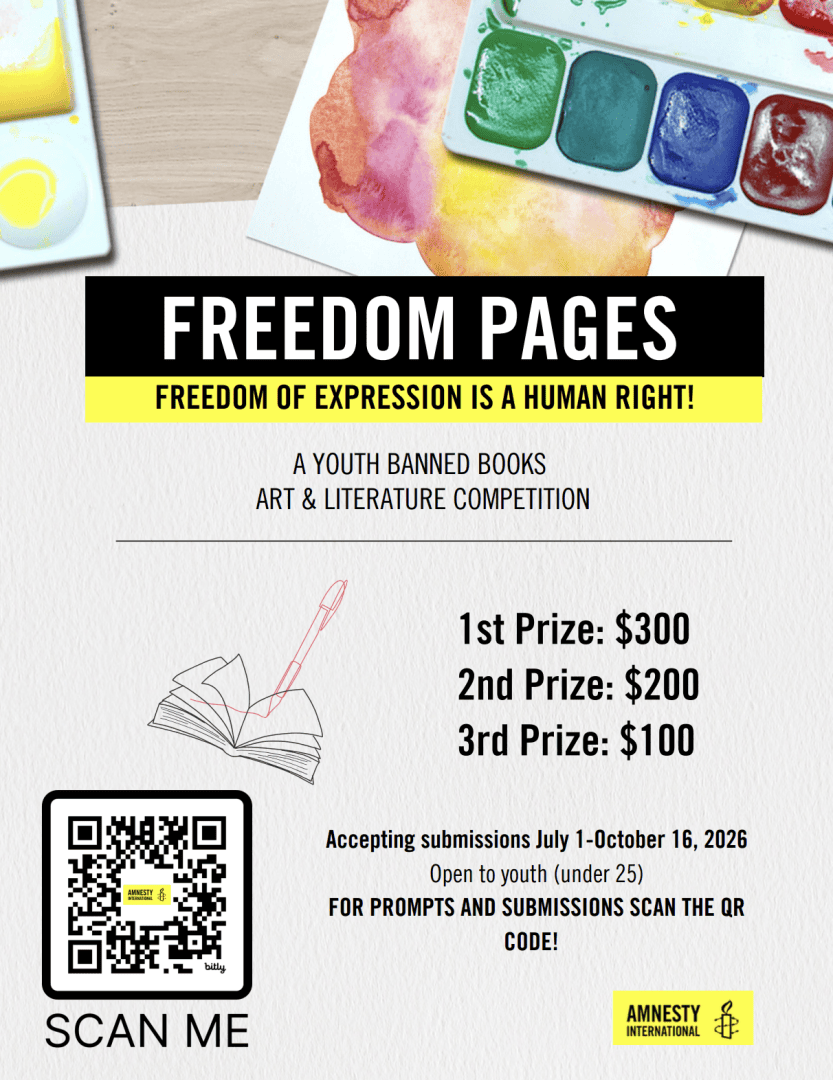
Submission Deadline: Submission deadline for this competition has been extended to Saturday, October 31, 2026, 11:59pm.
Please reach out to [email protected] if you have any questions.
We will be judging submissions based on theme, alignment with Amnesty International USA’s campaigns, technical skill, creativity, composition/structure, presentation/clarity, and message.
The submission deadline for this competition is Friday, October 16, 2026, 11:59pm. If you have any questions, please reach out to [email protected]. Good luck, we can’t wait to see your submission!