
The Current Crackdown on Students’ Rights
Our country is facing a crisis – and it is evident in how student protests have dominated news headlines over the past two years. From the violent repression of student activism on campuses to the elimination of diversity, equity, and inclusion programs across universities in the United States, young people are currently at the heart of authoritarian attacks and, therefore, vital in the ongoing fight to protect students’ rights.
Over the past two years, colleges and universities have become some of the most visible sites where the dynamics between institutional power and state surveillance have played out, laying bare for us to witness the rise of authoritarian practices. Some examples include:
- At Columbia University and City College of New York, nearly 300 students and community members were arrested for protesting the ongoing genocide in Gaza.
- Unarmed student protestors at UCLA and the University of Michigan were met with less-lethal munitions such as rubber bullets, tear gas, and chemical irritants to disrupt peaceful encampment demonstrations.
- More than 3,000 arrests have been made in connection with pro-Palestine campus protests.
- At least 8,000 foreign students and recent graduates have had their visas revoked by the Trump administration.
- In March 2025, Columbia University student activist Mahmoud Khalil was unlawfully and arbitrarily detained by immigration authorities and had his green card revoked for his role in peaceful protests at the University
- Leqaa Kordia, a Palestinian activist who protested the genocide having lost over 100 family members in Gaza, has been unlawfully and arbitrarily detained in an ICE facility in Texas and in deportation proceedings since March 2025.
At my own university, Harvard University, the Trump administration’s revocation of Harvard’s SEVP certification threatened the enrollment of international students on F-1 and J-1 visas. The Department of Homeland Security demanded extensive disciplinary records and full documented evidence, including “paper records, audio, and video of protest activity” of international students at Harvard spanning the past five years. Meanwhile, federal agencies gathered data of more than 100 students from the doxxing website Canary Mission to compile reports of student protestors nationwide. These crackdowns have paved the way for more extensive attacks on higher education, including the dismantling of DEI programs, affirmative action, international admissions, and academic departments, such as Studies of Women, Gender, and Sexuality and Ethnic Studies.
Why Students are Being Targeted
While this slew of attacks may appear unprecedented, they reflect a longer history in which universities have always existed at the center of tension between dissent and censorship, between political organizing and institutional neutrality. I’ve learned that universities can never truly be neutral; they are deeply embedded within the political systems that govern us, from the media and Congress to lobby groups and donors. Universities are bound to broader systems of social and political capital, wielding immense institutional power. Yet precisely for this reason, they have historically also been spaces where truth is sought, power is challenged, and dissent is not only tolerated but necessary.
The escalation of attacks on students’ rights raises urgent questions about the role of civic organizations like Amnesty International USA (AIUSA) in this current political moment. As one of the world’s largest and longest-standing human rights organizations, AIUSA provides critical infrastructure, resources, and legitimacy to build a broader, coordinated, youth-led movement against authoritarian practices.
What AIUSA’s Northeast Regional Activism Conference Made Possible
The Northeast Regional Activism Conference (RAC), held in Boston this past September, demonstrated what AIUSA’s infrastructure can make possible. As co-President of the Harvard Undergraduate Chapter of Amnesty International and a student organizer at Harvard, I served on the planning committee for the Northeast RAC. I opened the conference by identifying how authoritarian repression intends to isolate individuals and communities, making regional grassroots organizing increasingly necessary. At a time when students, including myself, are being doxxed, harassed, disciplined, and surveilled, convenings like RAC allow students, activists, and community members to gather together and recognize that their experiences and fears do not exist in isolation.
Through leading workshops on identifying tactics and strategies to respond to repression on campuses, I saw how young people were able to voice their concerns, identify shared patterns of repression, and begin developing a collective response to it. The RAC brought together students from all over the Northeast – UMass Amherst, Northeastern, Brown, Harvard, Tufts, Williams College, and high schools in Vermont. Students organizing around Palestine, racial justice, labor, education, LGBTQ rights, and immigrant rights came together not despite their different struggles, but because those struggles are connected by the same forms of repression. The RAC created a space to connect movements and groups that are often siloed and build solidarity grounded in shared values.
Creating Space for Solidarity
The Northeast RAC also created space to center the voices of student activists on the frontlines. I moderated a panel that brought together student organizers working across Palestine solidarity, racial justice, educational equity, and struggles for Uyghur and Tibetan freedom. AIUSA provided the platform for these students to discuss their experiences navigating political repression, allowing more AIUSA members to witness the realities these students have been enduring for years.
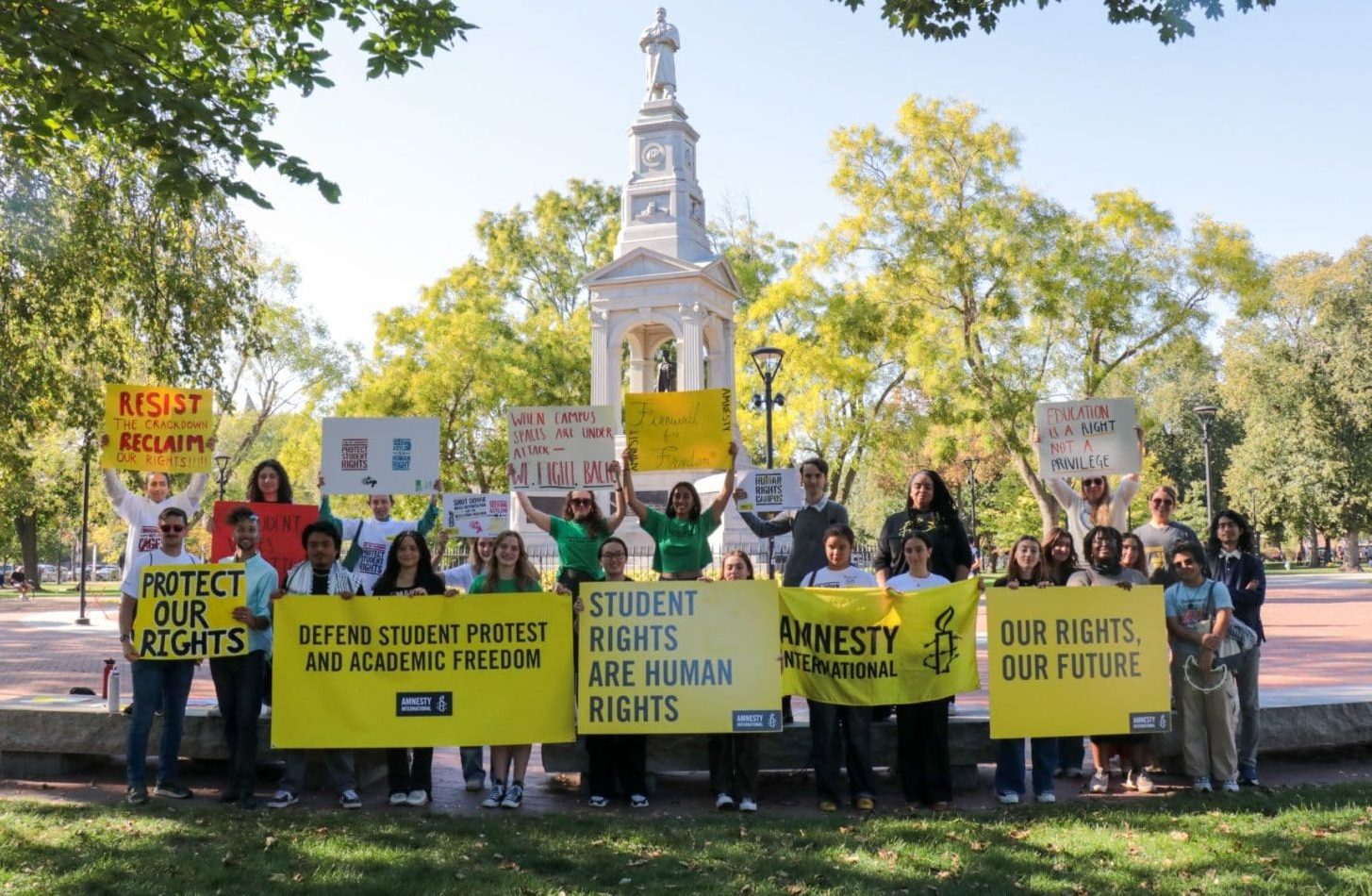
The conference culminated in a rally near Harvard’s campus to protest the closure of the Office for BGLTQ Student Life, the Women’s Center, and other campus spaces that were shut down in response to the Trump administration’s demands. Beyond symbolic action, the rally transformed people’s feelings and experiences into collective action, reaffirming the importance of student organizing, dissent, and defending civic space.
Youth Leadership as a Strategy for the Future
It is critical to understand the gravity of violence, harm, and surveillance that young people are being subjected to at this particular moment. Headlines do not offer a full picture. I constantly hear from my fellow students about the anxiety, fears, and uncertainty that we are constantly navigating. We live in unprecedented times, and it is difficult to know what will come next. However, while we cannot control the political conditions we are experiencing, we can build the critical infrastructure necessary to respond to them.
The Northeast RAC modeled how regional mobilization can transform fear into sustained momentum by cultivating space to intentionally build the solidarity that students and human rights activists need to keep organizing even after headlines disappear. But convening alone is not enough. To meet this moment, we must continue hosting townhalls, workshops, direct actions, webinars, teach-ins, creating toolkits and resource guides to build a durable organizing infrastructure that not only responds to authoritarian practices, but actively creates the conditions necessary to counter them. Young people, particularly students, must be at the center of these efforts, not only because they are disproportionately targeted, but because they will inherit both the challenges of the future and the responsibility to address them. As it has throughout its history, Amnesty International USA must continue to protect those most at risk in moments of political repression. It must continue to invest in youth leadership as a central strategy to create a future that is not only more resistant to authoritarian practices, but also more resilient, just, and grounded in the principles of human rights.