
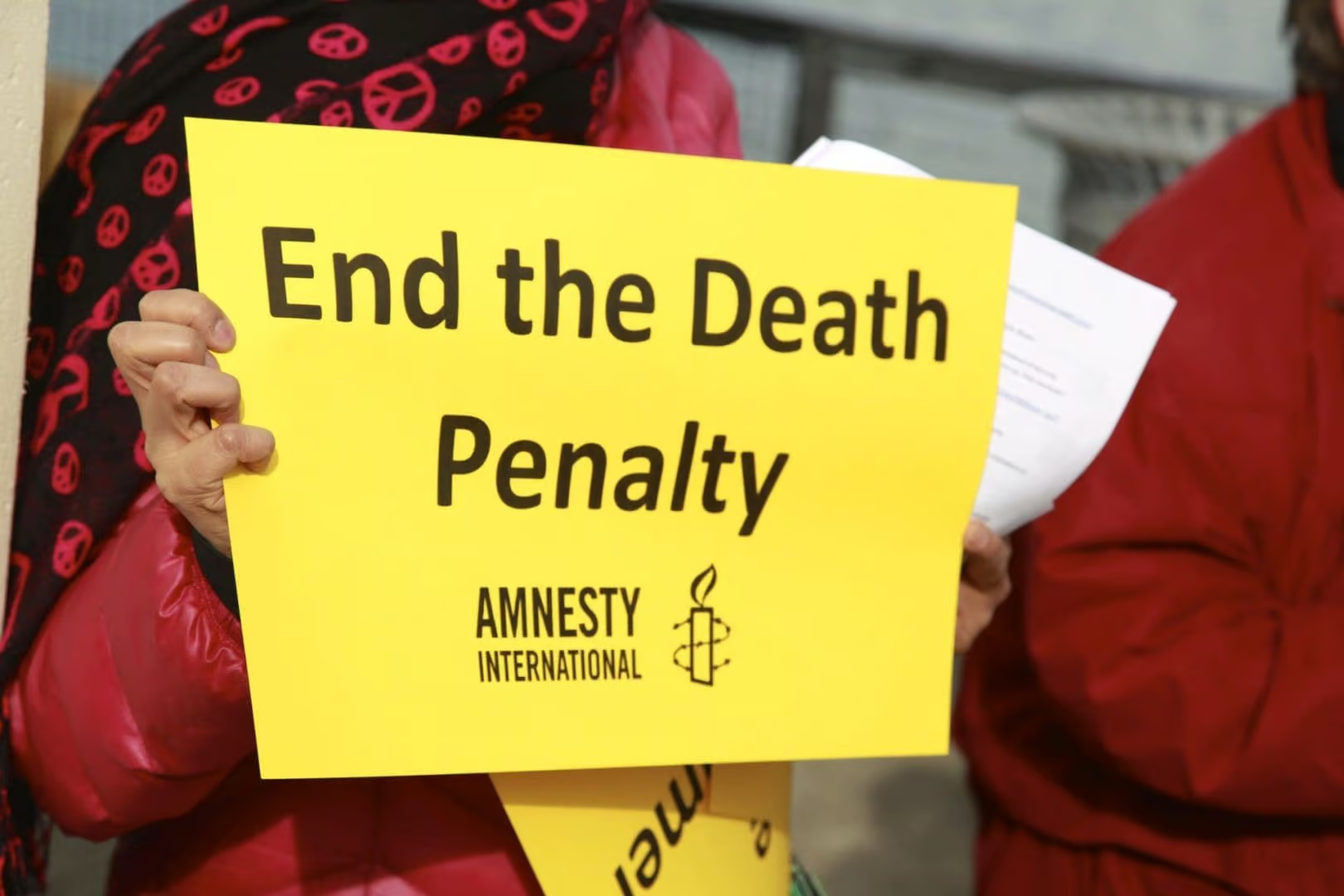
The death penalty is among the longest-running institution in the United States. As the country prepares to commemorate its 250th birthday, it’s past time to abolish the ultimate cruel, inhuman and degrading punishment.
Historical Overview of the Death Penalty in the U.S.
Colonial settlers brought the British system of justice to these shores in the first decade of the 17th century. Very little was written or spoken about or against the death penalty until the 1740s, an era known as “The Great Awakening,” but this first focus on the ills of capital punishment quickly passed with very few changes in its application.
Most executions in the colonies were public spectacles, designed to deter future “bad behavior” and to serve as a warning to those who would be found guilty of transgressing society’s laws. (We know today that the death penalty does not deter crime). Public executions, mostly by hanging and shooting, continued relatively unchallenged until the 1830s, when social justice reform efforts on a wide range of issues started, including the abolition of slavery, alcohol temperance, children’s rights, and early calls for women’s suffrage. By this point, the institution of capital punishment was already more than 200 years entrenched in the mindset and laws of this nation.
In the late 1800s, executions were moved inside prisons, where they have remained to this day. The use of the death penalty to enforce the institution of slavery has been very well documented, and to this day, vast racial disparities continue in its practice.
Over the years, new execution methods have been adopted, from electrocution, to gas chambers, to lethal injection, to most recently, the use of nitrogen gas. While the argument for these new methods has often been to make this archaic punishment more humane, the truth is there is no humane way to execute somebody.
The death penalty – no matter the method – is a violation of the human right to life.
The USA reached a peak of executions during the 1930s, with an average of 167 people executed per year. 199 executions were carried out in 1935, the most ever for a single year in U.S. history. It is estimated that over 15,000 people have shamefully been executed in the U.S. since colonial times.
The use of the death penalty declined in the 1940s, a decade in which an average of 126 people were executed. An average of 71 people were executed every year during the 1950s, and an average of 23 people a year were put to death between 1960 and 1967, when a hiatus on executions began. No one was executed from 1968 to 1976. 1976
Step forward for human rights: national pause on executions in the U.S.
On June 29, 1972, the United States Supreme Court ruled in Furman v. Georgia that the death penalty was “arbitrary, capricious and discriminatory.” While the Justices were unable to agree on a single reason for the death penalty laws to be unconstitutional, in separate concurring opinions the Justices pointed to the fact that the death penalty was heavily applied to poor and/or Black Americans or that it was applied so infrequently and arbitrarily that it served no penological purpose, basically becoming purposeless vengeance, an immoral proposition, which led to discriminatory outcomes and likely the execution of people with claims of innocence. The Court further declared that all existing state death sentences and statutes violated the Eighth Amendment’s ban on cruel and unusual punishment as well as the Fourteenth Amendment’s right to due process.
In a step forward for human rights, nearly 40 death penalty statutes nationwide were voided, and everyone was removed from state death rows. Finally, there was a suspension on all U.S. executions.
States work around this ruling
In the years that immediately followed the Furman decision, rather than eliminate the death penalty, some states revised their capital statutes to prepare for new parameters they hoped the Supreme Court would deem workable and constitutional at a future date, typically by removing unbridled jury discretion.
The Florida legislature became the first state to implement new capital statutes and guidelines in December 1972, only six months after the Furman decision. Ultimately, 35 states rewrote their capital statutes. The new statutes fell under two different types of guidelines: namely, “guided discretion” or “mandatory,” and ultimately the U.S. Supreme Court accepted to review challenges to statutes arising from cases in five states: Florida, Georgia, and Texas with “guided discretion” statutes and from Louisiana and North Carolina with “mandatory” guidelines.
In dismal day for U.S., Gregg v. Georgia reinstates the death penalty
On July 2, 1976, the Court ruled to uphold the constitutionality of the death penalty in the case of Gregg v. Georgia, Profitt v. Florida, Jurek v. Texas, Woodson v. North Carolina, and Roberts v. Louisiana. This decision reaffirmed the Court’s acceptance of the use of the death penalty in this country, and began what is now considered the onset of the modern era of capital punishment in the USA.
The Court threw out the “mandatory” guidelines of both North Carolina and Louisiana and thus ruled only affirmatively on the cases from the other three states. In a dismal day for the U.S., this decision effectively gave the green light for executions to proceed under amended laws.
The first execution was carried out six months later, when Gary Gilmore was executed by firing squad in the Utah State Penitentiary on January 17, 1977.
How I got involved in the abolition movement
On a personal note, I remember both the Furman and Gregg decisions as if they happened yesterday. I was a graduate student at the time of both decisions. I believed deeply—as I still do—that the death penalty is cruel and anathema to human rights.
On July 2, 1976, I remember it being announced on the evening news that the Court had reached its decision on Gregg v. Georgia. Some friends had thrown me a birthday party, but everyone knew the Court decision was coming. The festiveness of the birthday gathering abruptly ended as soon as the decision was announced.
Our organizing efforts to abolish the death penalty began the following day, preparing to work against the re-imposition of the death penalty in Alabama. I joined Amnesty International USA in 1971 and welcomed the organization’s decision to oppose the death penalty without reservation in 1977.
On June 29, 1994, I was one of only four people who gathered at the Supreme Court, initiating what has become the annual four-day Fast & Vigil, commemorating both the joy of the Furman decision and the anguish of Gregg.
The work to abolish the death penalty continues
And so here we are, 50 years later.
But unlike 1976, the execution landscape is markedly different. Since the Gilmore execution, the nation has carried out an additional 1,668 executions and has added two more methods to its death penalty arsenal: lethal injection (first used on December 7, 1982, in Texas) and nitrogen hypoxia (first used on January 25, 2024, in Alabama).
The U.S. has more methods of killing people (six) than in any other country in the world. But no matter the method, the inherent cruelty of the death penalty remains evident in each execution. There simply is no humane way to execute somebody.
Since 1976, an overwhelmingly pro-death penalty U.S. Supreme Court has ended the use of peremptory challenges to exclude potential jurors based solely on their race during jury selection (1986), executions for those with severe mental disabilities (1986), the practice of judges imposing death sentences instead of juries (2002), executions for individuals with intellectual disabilities (2002), and executions for juvenile offenders (2005).
Many states have moved away from the death penalty. The number of states allowing execution has gone from 40 to 27, and the number of people on death row has been reduced from over 4,300 to under 2,000 people for the first time since the 1980s. National death sentencing and annual executions have decreased over the years.
But this struggle is far from over. In 2025, the number of executions in the U.S. nearly doubled from those just a year before. 50 years have passed since the Gregg decision, and the country is still wedded to the ideology of killing in the name of the law. It is the ultimate, irreversible denial of human rights.
Death penalty on the United States’ 250th and beyond
This July 4th, there is much to contemplate about our national health, and who we truly have been, are, and want to be as a people. There is an abundance to celebrate and to be thankful for the opportunities we have.
It is imperative, especially for the younger generation(s), to reflect upon what they want this country to be, and what kind of society and world they want to help shape.
I look forward to the day in the future that the Gregg decision is overturned; when a different Supreme Court decides to chart a new path forward for this nation, committing itself to the defense, protection and advocacy of human rights for all people in this country by announcing that we are, at long last, a death penalty-free nation.
Until then, the job of our younger abolitionists is to help lead this country forward so that every future July 4th can be celebrated in a country committed to human dignity and human rights.
Learn more about AIUSA’s work to abolish the death penalty