
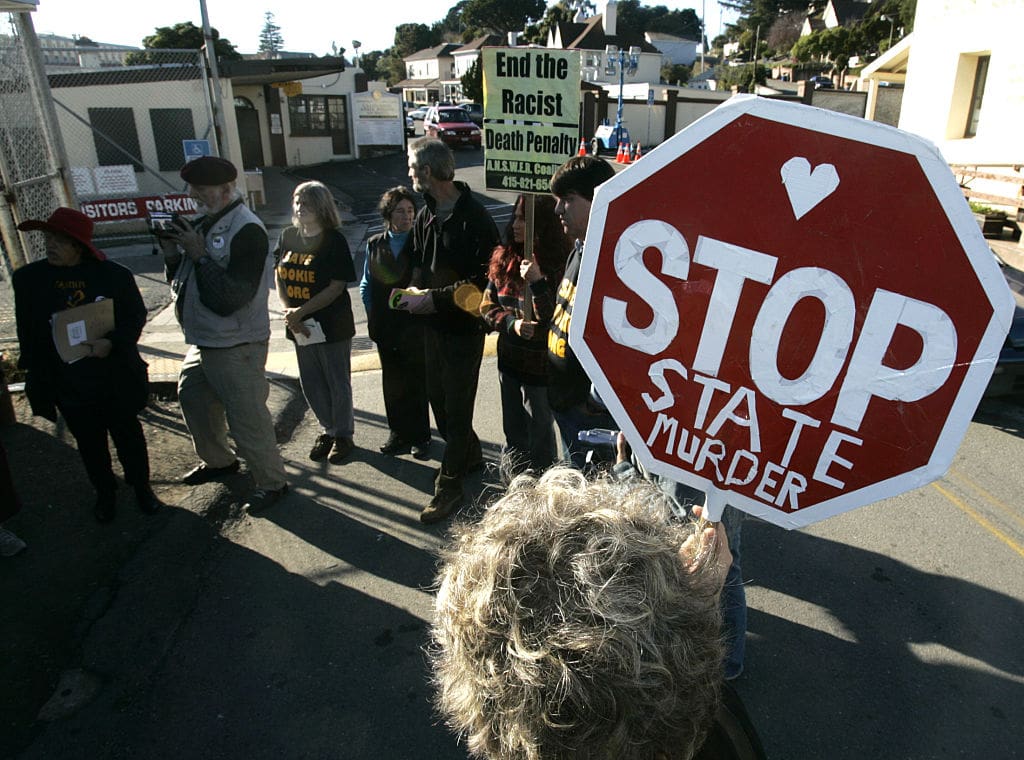
(Mark Boster/Los Angeles Times via Getty Images)
Governor Gavin Newsom has made his position against the death penalty very clear. In 2019, he said, “My ultimate goal is to end the death penalty in California.” Governor Newsom leaves office in January 2027. It is time for him to show his leadership and act.
- According to the California Department of Corrections and Rehabilitation, as of May 2026, California facilities hold over 550 people under sentence of death. That’s more than 25% of all people with death sentences in the entire U.S.
- The last execution in California was carried out in 2006. Since the U.S. Supreme Court declared in 1972 that the death penalty laws at that time were unconstitutional, there have been 13 executions in this state, carried out between 1992 and 2006.
- Two months after taking office as governor of California, Gavin Newsom issued Executive Order N-09-19 to establish an official moratorium on executions, repeal the state lethal injection protocol and dismantle the execution chamber at San Quentin prison. In his order, Governor Newsom described California’s death penalty system as “unfair, unjust, wasteful, protracted [which] does not make our state safer,” in which “death sentences are unevenly and unfairly applied to people of color, people with mental disabilities, and people who cannot afford costly legal representation.”
- The use of the death penalty in California has been afflicted by racial discrimination and has been weaponized against communities of color. In one example, a federal judge ordered the District Attorney of Alameda County on April 22, 2024, to review 35 death penalty convictions spanning nearly a two-decade period after it was disclosed that several prosecutors intentionally excluded Black and Jewish people from serving on capital murder trials in 1995 through discriminatory jury selection tactics. Governor Newsom has acknowledged in a court intervention that the death penalty in his state is discriminatory. The Racial Justice Act, which first came into force in 2020 and was subsequently amended, prohibits racial discrimination in all criminal prosecutions. They expand the grounds through which racial discrimination can be shown compared to the standard set by the U.S. Supreme Court and provide for avenues for redress and applied retroactively.
- Protections under California laws to exclude those with mental and intellectual disabilities, who are at greater disadvantage in their experience of the criminal justice system, from the use of the death penalty have long been inadequate. Figures in the death penalty report of the state Committee on the Revision of the Penal Code indicated that one third of individuals held on death row as of 2021 were being treated for severe mental disabilities. On September 28, 2024, Governor Gavin Newsom of California signed into law a bill to ease the evidentiary threshold needed to exclude people with intellectual disabilities from the use of the death penalty.
- Access to legal assistance remains a challenge, including for those who want to apply for a review of their death sentence under the Racial Justice Act.
- In 2016, instead of supporting a ballot initiative to replace the death penalty, California voters adopted Proposition 66. It aimed to speed up the appeal process in capital cases to facilitate executions and required those under sentence of death to work and pay restitution to their victims as they serve their sentences.
- Starting with a pilot project in 2020, the authorities established the Condemned Inmate Transfer Program (CITP) to transfer those held on death row at San Quentin to the general population in facilities across the state that have an electrified secured perimeter. The relocation also led to greater access to rehabilitation programs and training.
- Eight men on death row, including six Black men, one Latino and one Alaska Native, were exonerated in California between 1981 and 2024, according to the Death Penalty Information Center. Official misconduct and inadequate legal representation were common factors in their cases.
- Governor Newsom can take action to secure the commutation of all death sentences in California. According to the California Constitution, the governor can direct the commutation of death sentences imposed on people who do not have a separate felony conviction, approximately 40% of the total. For those with a separate felony conviction, the governor must submit his request to the California State Supreme Court, which must grant the recommendation to the commutation with the majority of four judges.
Urge Governor Newsom to Commute All Death Sentences in California