
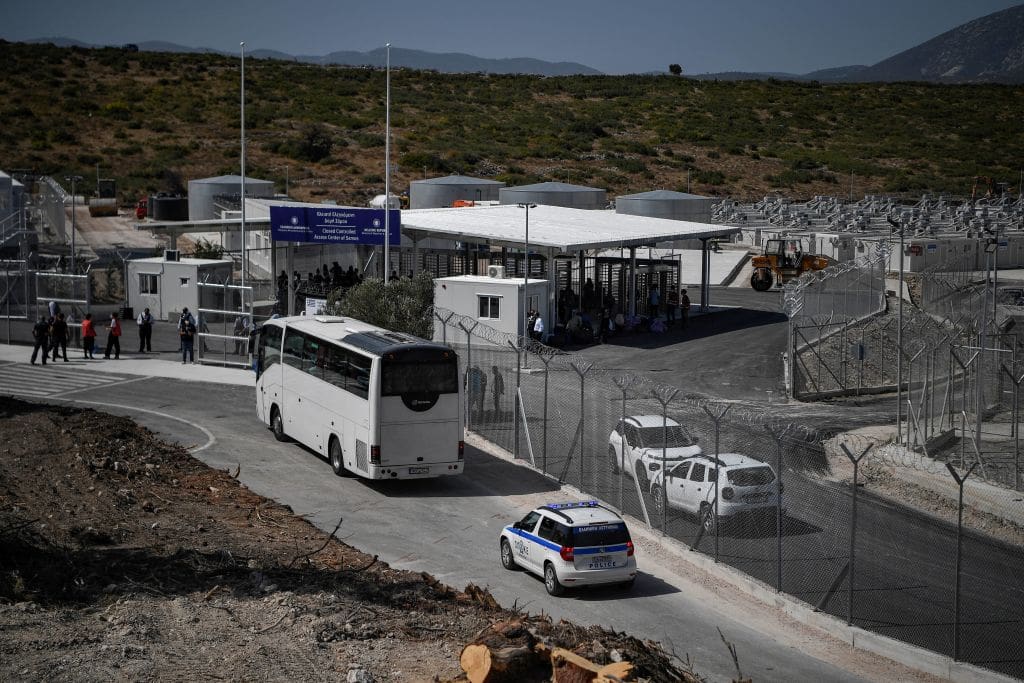
Asylum-seekers staying in a new EU-funded refugee camp on the island of Samos are being detained illegally by Greek authorities following a yet unpublished decision from the Greek Minister for Migration and Asylum, based on information received by Amnesty International.
In line with the decision, since November 17 those without valid government-issued IDs (asylum cards) are barred from leaving the camp for an indefinite period of time. The decision applies to individuals who have had cards withdrawn as a result of unsuccessful asylum applications or newcomers yet to be issued with a card. According to unofficial estimates, around 100 of the approximately 450 residents have been prevented from leaving the prison-like premises for more than two weeks, in violation of their right to liberty.
“This camp more closely resembles a prison than a place to house people seeking safety. This is a gross misuse of EU money, and a gross abuse of the residents’ rights,” said Adriana Tidona, migration researcher at Amnesty International.
The new EU-funded “closed-controlled centre” (KEDN) of Samos has been constructed in an isolated spot 6 km from the main city, Vathi. It can house up to 3000 people and is equipped with a rigid system of containment and surveillance, including double barbed wire metal fencing, CCTV throughout, and the 24/7 presence of patrolling police officers and privately contracted security officers.
Residents’ movements in and out of the camp, which are only allowed between 8 am and 8 pm, are subject to security checks, and take place via magnetic gates.
Individuals and families affected by the November 17 decision cannot leave the camp to perform daily chores, attend classes or community activities at the nearby NGO-run “Alpha land”, or to reach the city centre.
A., an Afghan man from Kabul, staying in the camp with his wife and children, has been in Greece since January 2020. His asylum claim was rejected multiple times and his asylum card withdrawn, leaving him unable to leave the facility. Before being transferred to KEDN, he and his family lived in the “jungle”, a spill-over settlement around the old Samos camp, infamous for its abysmal living conditions.
Speaking from the container where he lives with his family, he told Amnesty International that there is more security in the new camp, but notes: “They have been treating us like prisoners…You really go insane in this place. You can’t go back. You can’t go forward…I cannot really sleep…All the time we are living life with no purpose, with a lot of anxiety.” For the past five days, only his children have been allowed out of the camp to go to school.
H., an Afghan man in Greece since February 2020, whose asylum claim was twice rejected, has not left the camp for five days. Before the November 17 decision, he was active outside the camp: “I was studying English and volunteered outside the camp. In the last five days I feel that I am a prisoner. In the old camp, at least, I had my freedom.”
Amnesty International repeatedly expressed concerns about Greece’s replacement of open camps with “closed controlled centers”, questioning how the policy could be reconciled with human rights standards on the deprivation of liberty. Under international and EU law, asylum-seekers should only be detained as a matter of last resort, after a detailed examination of their individual circumstances, for the shortest time possible and under a procedure prescribed by law which allows them to challenge the decision.
The residents of Samos camp are being deprived of their liberty automatically and en masse, on untransparent and illegitimate legal grounds, without being able to challenge their confinement, for an indefinite period of time.
“As we feared, Greek authorities are hiding behind the legally ambiguous concept of so called closed-controlled centers to illegally deprive asylum-seekers of their liberty. We call on Greece to urgently withdraw this decision and lift the restrictions on the residents of Samos camp. The European Commission must also ensure respect for fundamental rights within EU funded facilities,” said Adriana Tidona.
Background
An Amnesty International delegation visited the premises of the Samos “Closed Controlled Island Facility” (in Greek: Κλειστή Ελεγχόμενη Δομή Νήσων, KEDN) on November 22, 2021, on the fifth day of the restrictions, and met some of the affected residents.
The Samos KEDN was established with the help of 276 million EUR funding allocated by the European Commission for the construction of new facilities for asylum-seekers on the Aegean islands, to replace the existing Government-managed open camps.
On November 27, the Greek authorities inaugurated the KEDNs on Leros and Kos. Further KEDNs on Lesvos and Chios will follow.
In addition to restrictions of movements in Samos, asylum-seekers across Greece have not been provided with any financial assistance for two months after it abruptly stopped when the management of the EU-funded cash assistance program transferred from UNHCR to the Greek authorities. According to NGOs in Greece, approximately 34,000 asylum seekers are currently affected.
According to NGOs, since October 2021 Greek authorities have also stopped the provision of food and water to recognized refugees, and to asylum-seekers whose application was rejected.
Contact: Gabby Arias, [email protected]